
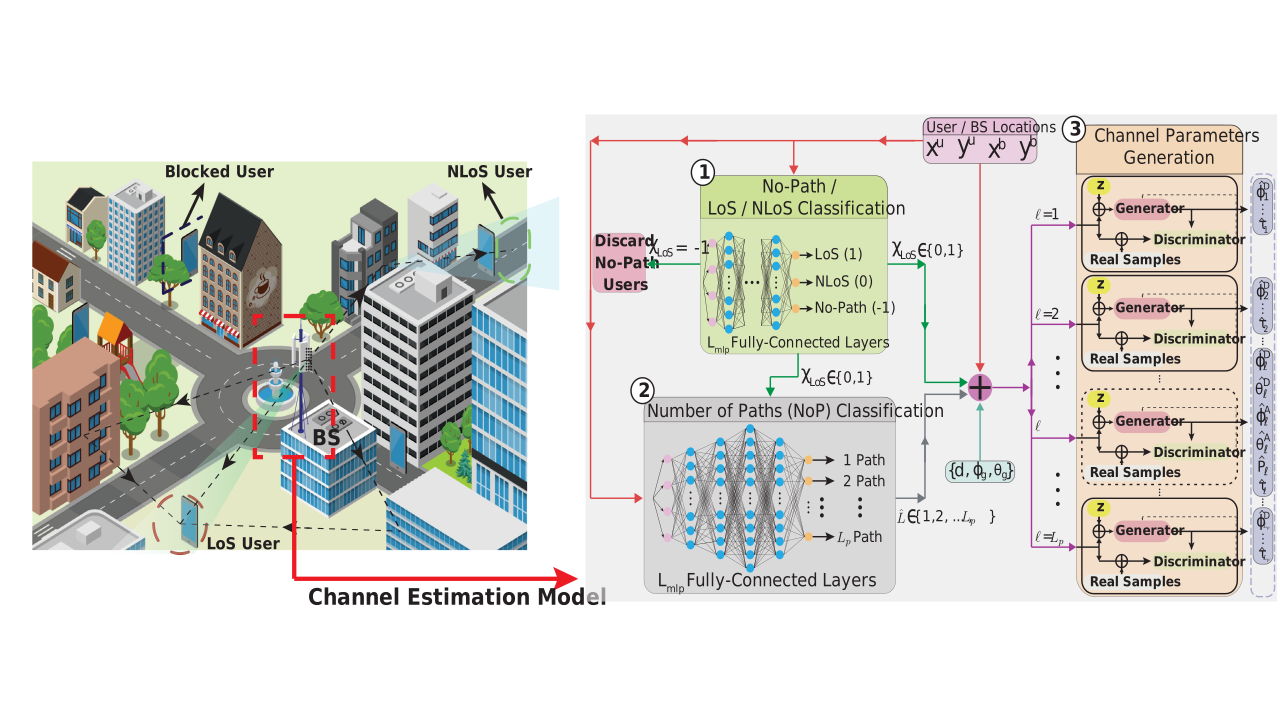
Generative AI-Based Channel Estimation Framework: CG-CGAN
Overview
Generative artificial intelligence (GenAI) is reshaping wireless communications by moving beyond data-driven modeling to directly generating multiple components of the channel. This is especially important for millimeter wave (mmWave) massive MIMO (mMIMO) systems, where high-dimensional channels, low signal-to-noise ratio (SNR), and hybrid architectures make channel estimation difficult. Traditional compressed sensing (CS) and deep learning (DL) approaches are either too computationally heavy or not accurate enough. Our research introduces a generative learning framework that leverages user equipment (UE) and base station (BS) locations to synthesize channel parameters with minimal pilot overhead, enabling efficient and accurate estimation for next-generation 6G systems.
System Model
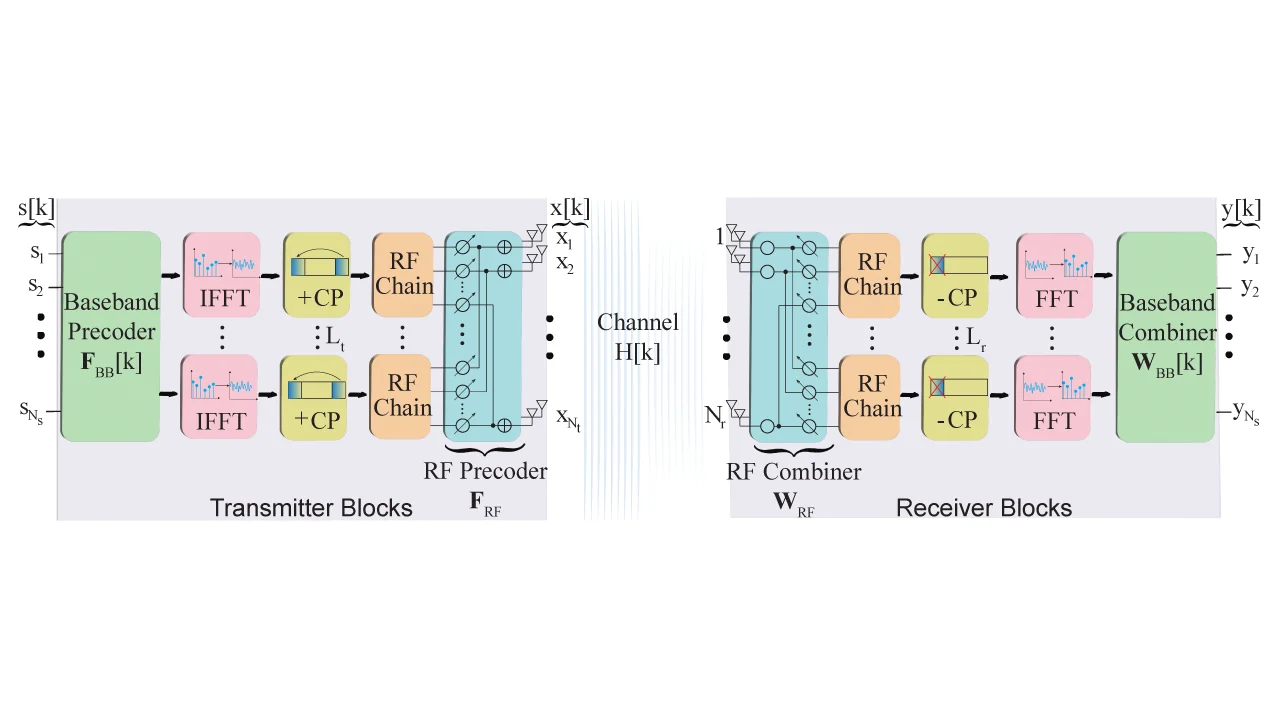
We consider a hybrid mmWave mMIMO system where both the transmitter (TX) and receiver (RX) employ large antenna arrays, but only a limited number of radio frequency (RF) chains. This architecture reduces hardware cost and energy consumption but complicates the channel estimation (CE) task, as only compressed observations of the channel can be collected. The wireless channel is modeled as a frequency-selective multipath environment, where each path is characterized by angle of arrival (AoA), angle of departure (AoD), time of arrival (ToA) / delay, and received power. This sparse geometric representation forms the basis for efficient learning and reconstruction.
Proposed Technique
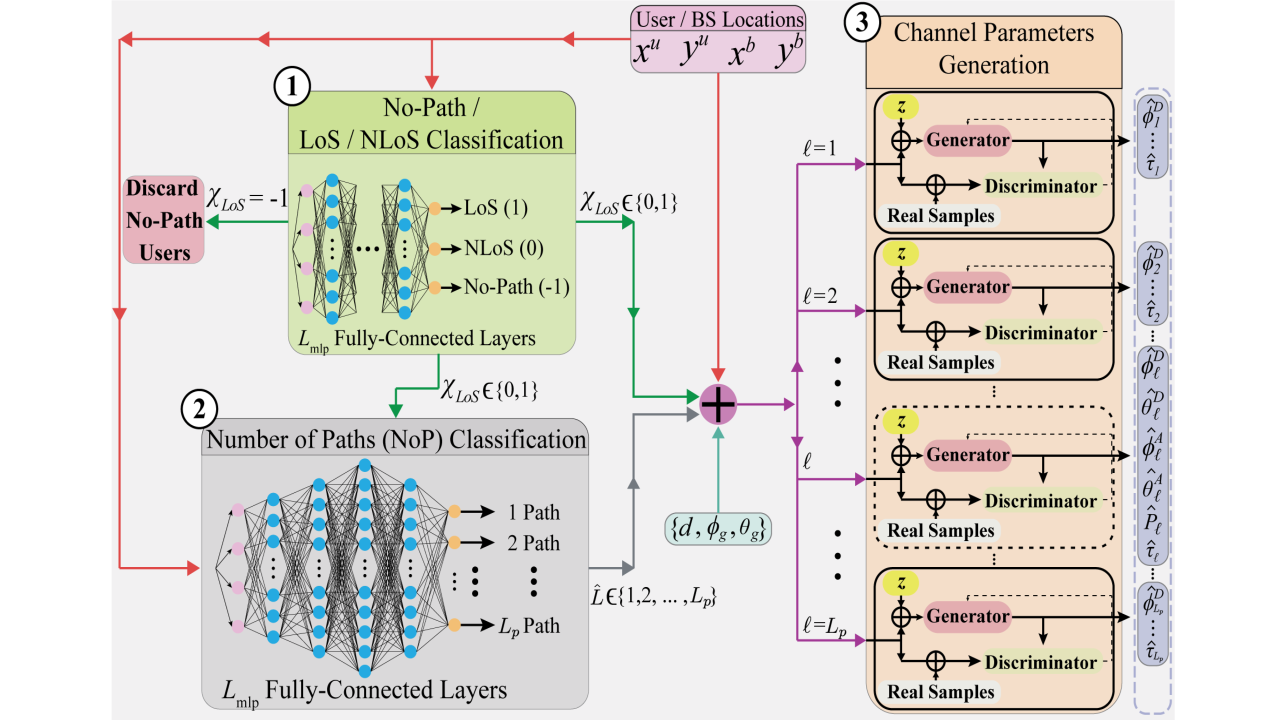
We propose a Classifiers-Guided Conditional Generative Adversarial Network (CG-CGAN) framework that directly generates channel parameters from location information. This pipeline first classifies the link status (LoS, NLoS, or blocked) and predicts the number of propagation paths. Then, CGANs generate high-fidelity angular parameters, while lightweight least-squares estimation recovers path gains. Unlike iterative CS, our solution infers angular support in one shot, making the reconstruction process both faster and more scalable.
Results
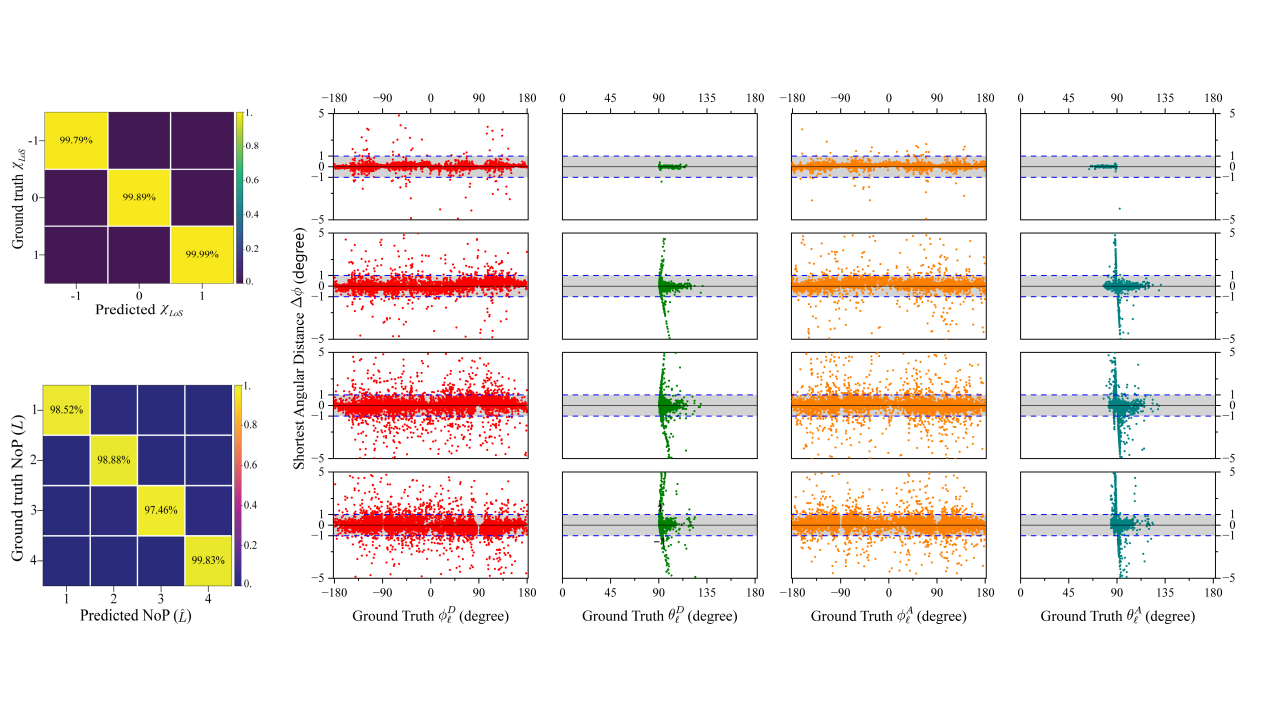
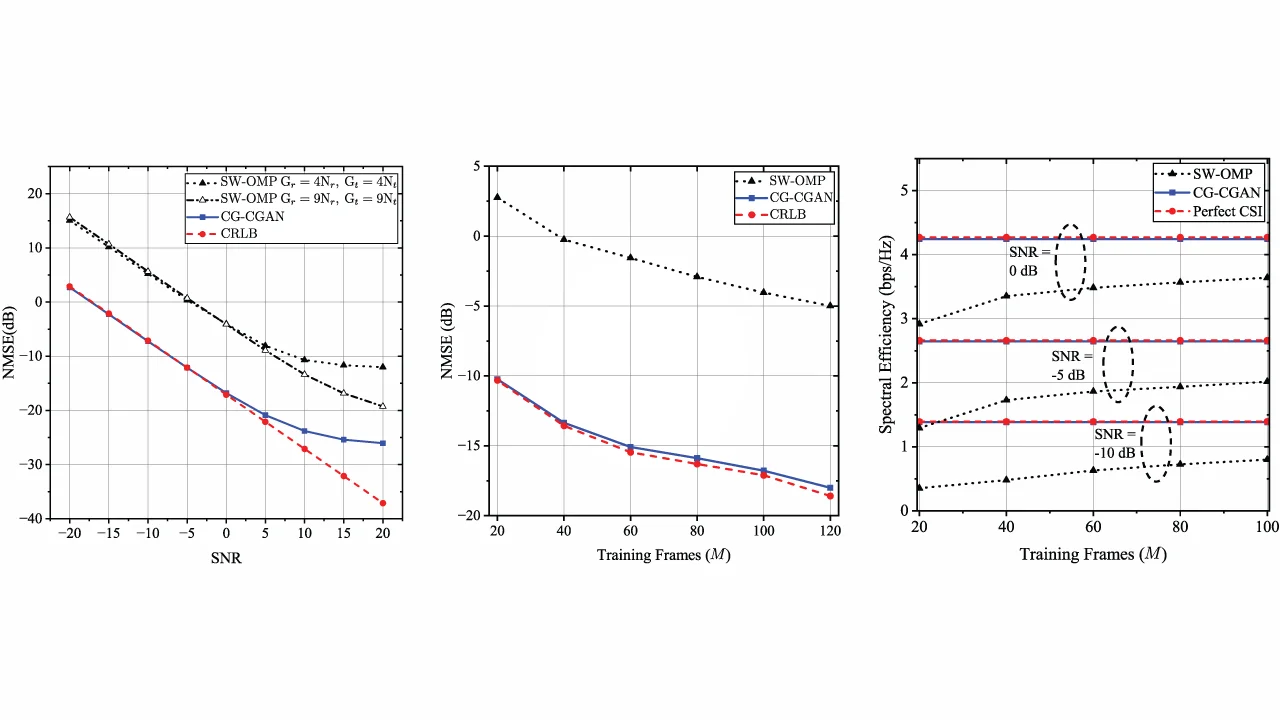
Simulations on the DeepMIMO dataset confirm that CG-CGAN delivers highly accurate and efficient channel estimation. The classifiers achieve over 99.5% accuracy; angular predictions exceed 92%.
The overall reconstruction attains near-optimal NMSE performance by closely following the theoretical Cramer-Rao lower bound (CRLB). Importantly, our method runs more than three orders of magnitude faster than state-of-the-art compressed sensing algorithms, like simultaneous weighted orthogonal matching pursuit (SW-OMP), while maintaining robustness under limited pilot symbols (training frames), reduced RF chains, and diverse antenna configurations. These results highlight the practicality of our approach for real-world 6G deployments.
How to reproduce results
A step-by-step implementation of the proposed technique and models in this work is available on the following link:
https://github.com/yildirimbk/CG-CGAN-Angle-Generation-and-Channel-Estimation-Framework