
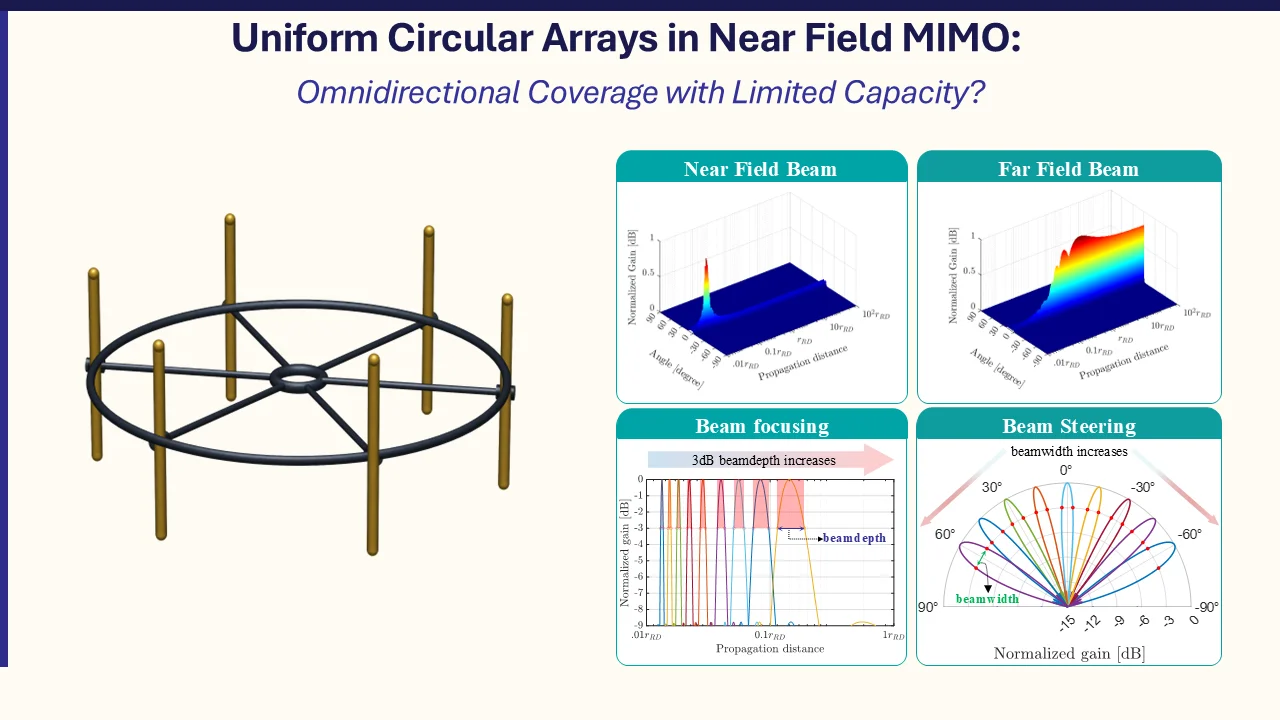
Uniform Circular Arrays in Near-Field: Omnidirectional Coverage With Limited Capacity
Overview
•Background: Ultra-massive MIMO in the radiative near-field uses spherical wavefronts to create finite-depth beams, separating users by distance and angle. Uniform Linear Arrays (ULAs) restrict finite-depth beams primarily to the boresight. Uniform Circular Arrays (UCAs) offer rotational symmetry, expanding angular coverage. Does the omnidirectional coverage of a UCA inherently translate into improved spatial multiplexing and sum-rate capacity compared to a ULA?
•Methodology: Traditional Rayleigh distance overestimates the near-field region. We utilize the Effective Beamfocusing Rayleigh Distance (EBRD)—a precise, angle-dependent boundary where beamfocusing remains effective. Formulated novel closed-form mathematical expressions for beamdepth and EBRD specific to UCA geometries. Conducted comparative capacity and spatial correlation analyses.
•Results: The main results are summarized below:
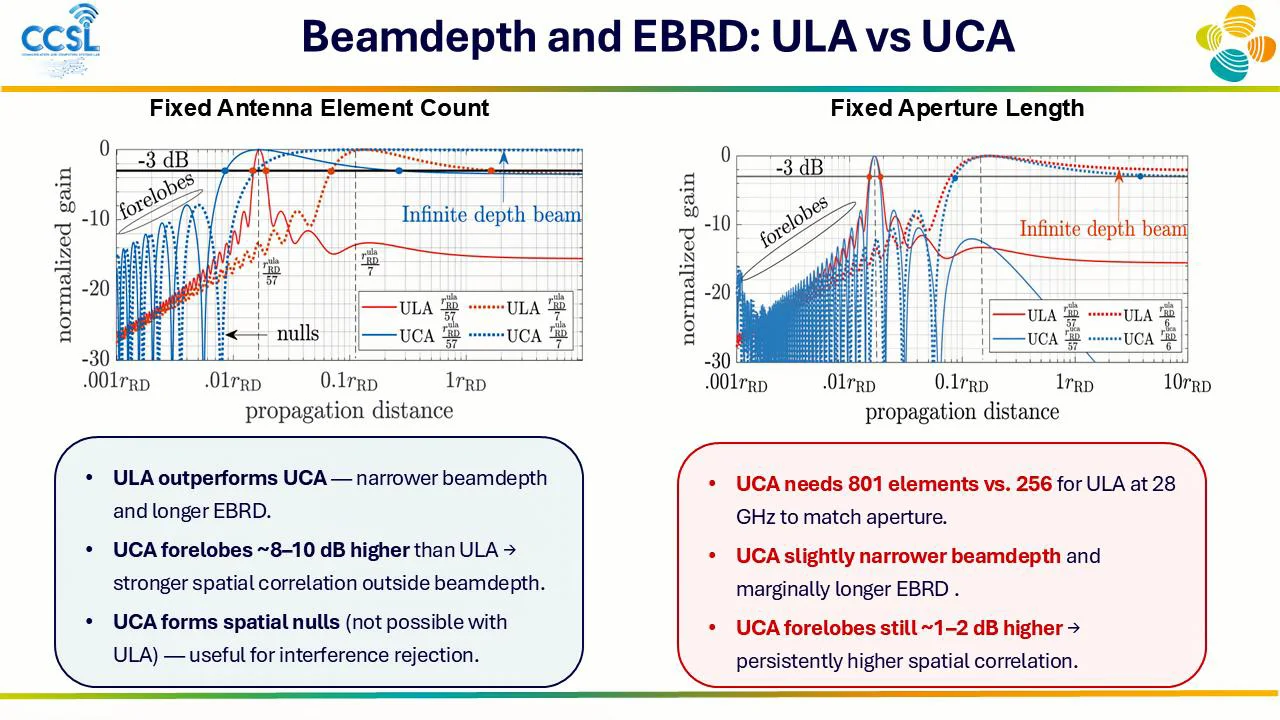
Design Constraint | Beamdepth & EBRD Performance | Sum-Rate (Capacity) Impact |
Fixed Antenna Element Count | ULAs achieve a significantly narrower beamdepth and a more extended EBRD than UCAs. | ULA Wins. The ULA achieves a higher multi-user sum-rate due to reduced inter-user interference. |
Fixed Aperture Length | UCAs provide a slightly narrower beamdepth and a marginally longer EBRD. | UCA Wins (Marginally). The UCA offers a marginal capacity improvement, particularly under high user loading. |
Read the Paper & Access Source Code
💻 Source Code: https://github.com/ahmedhussain214/Uniform-Circular-Arrays-in-Near-Field