Wire-Free Wearables: Adaptive Low-Power Transceivers for Human Body Communication
Overview
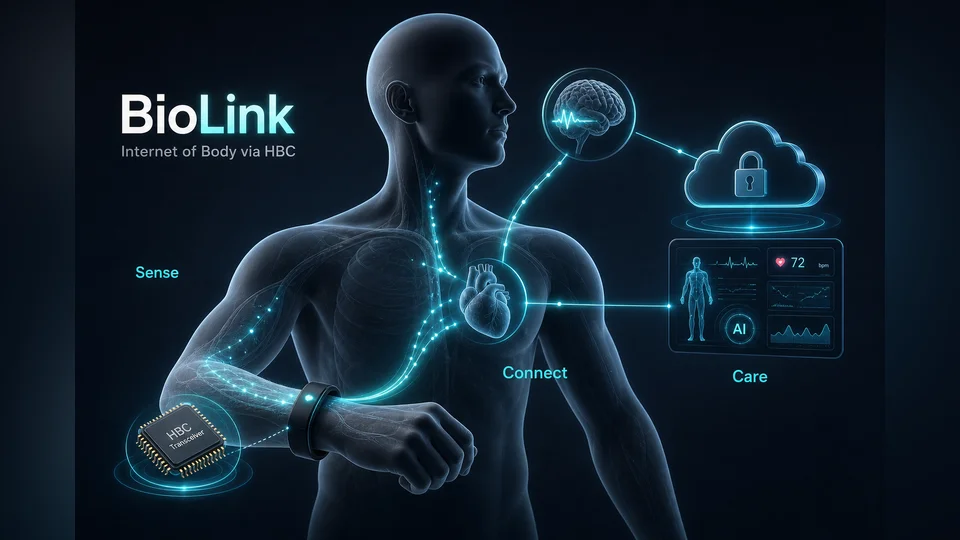
Wearable and implantable sensing is limited by its radio, not by its sensor. On the body, conventional RF links suffer shadowing and multipath, radiate energy into the surrounding room, and end up dominating the power budget of a node whose battery has to be small enough to wear. Human Body Communication (HBC) removes that radio: the signal is coupled into conductive tissue through skin electrodes and travels along the wearer, cutting transmit energy by orders of magnitude while keeping the data confined to the person carrying it.
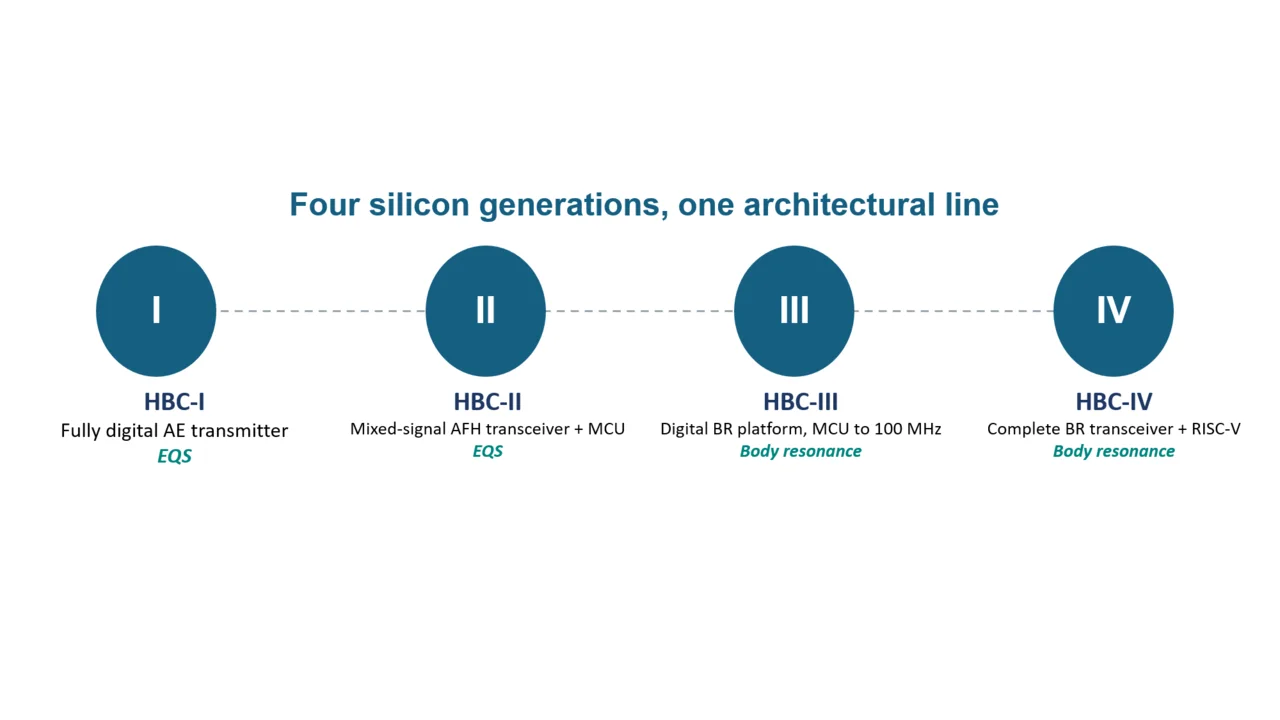
This project is the analog / mixed-signal integrated-circuit thread of the CCSL HBC programme. It is not a single demonstrator but a deliberate sequence of four taped-out generations in TSMC 65 nm CMOS — HBC-I through HBC-IV — each closing one specific gap between what HBC promises on paper and what a wearable can actually be built from: transmitter energy, interference robustness, throughput, and finally full transceiver integration with on-chip processing and sensing on a single die.
That silicon then becomes a platform for applied work: privacy-preserving in-car driver state monitoring, non-invasive hydration status detection that reuses the communication channel itself as a biomarker, and NABDH — a wireless Holter for continuous cardiac monitoring, awarded a Gold Medal at the International Exhibition of Inventions of Geneva 2026.
4 tapeouts in TSMC 65 nm | 65 nW TX core power | 1.3 pJ/bit energy efficiency | >100× more efficient than on-body RF |
System Model — the body as a channel
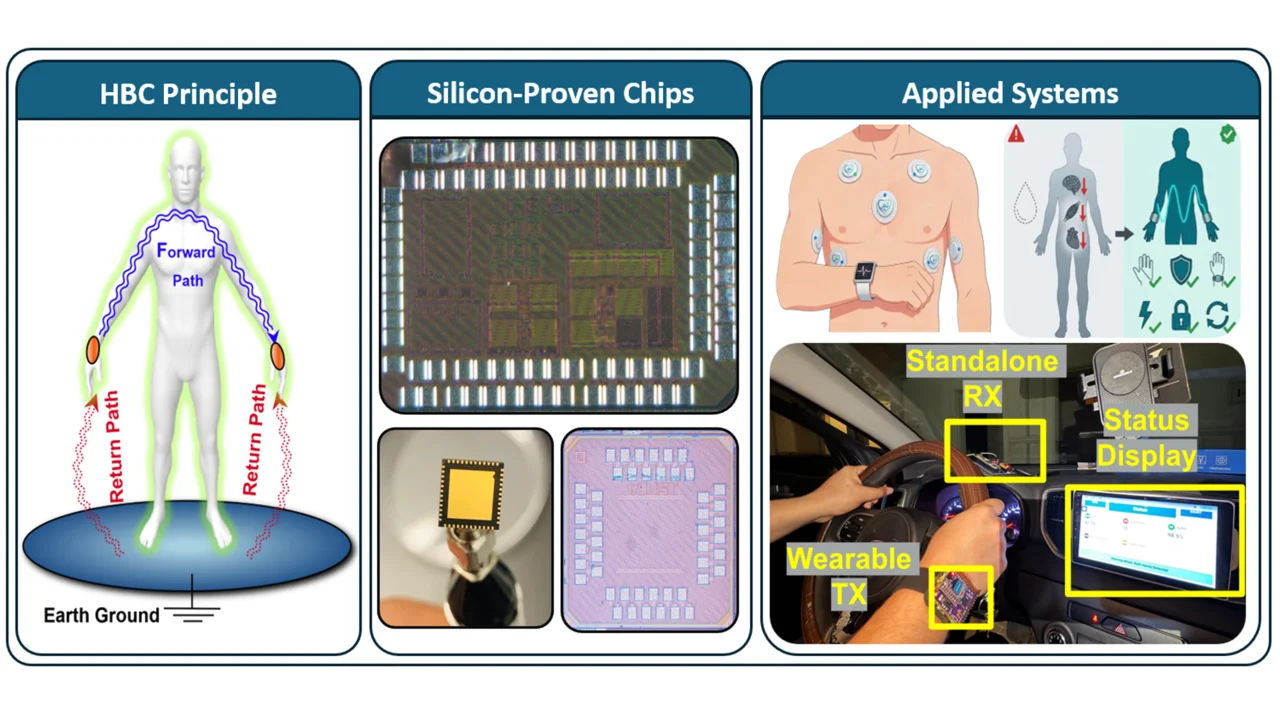
In capacitive-coupled HBC the transmitter drives a signal electrode against the body while the return path closes through the environmental ground. The body behaves as a lumped, largely capacitive network whose transfer function depends on electrode geometry, posture and skin state. Two operating regimes matter to the circuit designer, and they call for different front-ends:
A · Electro-quasistatic (EQS) — below ~10 MHz
→ HBC-I · HBC-II | B · Body resonance (BR) — ~40–120 MHz
→ HBC-III · HBC-IV |
Four silicon generations, one architectural line |
|
Proposed Technique — four silicon generations
Each chip is a full tapeout in TSMC 65 nm, and each answers the question the previous one left open. Below, one card per generation: the problem it targets, the circuit idea, and what the silicon does.
HBC-I: Fully digital transmitter with a pre-trained autoencoder encoder
HBC links are power-asymmetric: the body-worn transmitter runs from a coin cell, while its receiver — built into a car, a bed rail, a piece of clinical equipment — is mains-powered. HBC-I exploits that asymmetry. The learned symbol-to-waveform mapping of an autoencoder is trained offline and hardcoded in silicon with resource-shared weights, removing memory-access overhead entirely, while the matching decoder stays fully reconfigurable on an FPGA-based standalone receiver. All the machine-learning adaptability lives where the energy is.
- Silicon: TSMC 65 nm CMOS · 0.01 mm² · 0.7 V supply · fully digital implementation flow.
- Two modes without any hardware change — AE-OOK (narrowband, programmable carrier) and AE-Only (broadband baseband).
- Data rate 2.3 kbps – 1 Mbps; TX core power 65 nW – 1.4 µW; energy efficiency 1.3 – 31.4 pJ/bit.
- 33 % and 74 % longer communication range than conventional OOK and AE-Only respectively, measured end-to-end.
- Practical EQS-band noise surveys across real environments yield carrier-selection guidelines and data-rate-to-carrier ratio limits for reliable OOK demodulation.
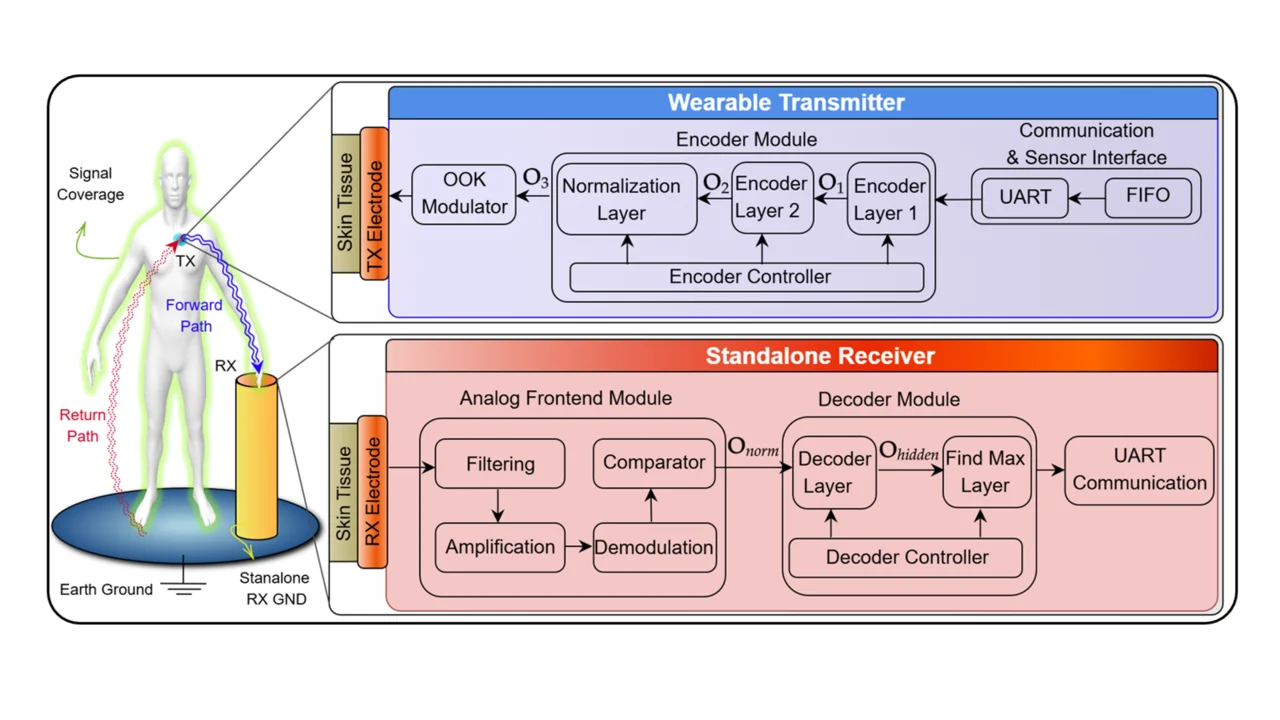
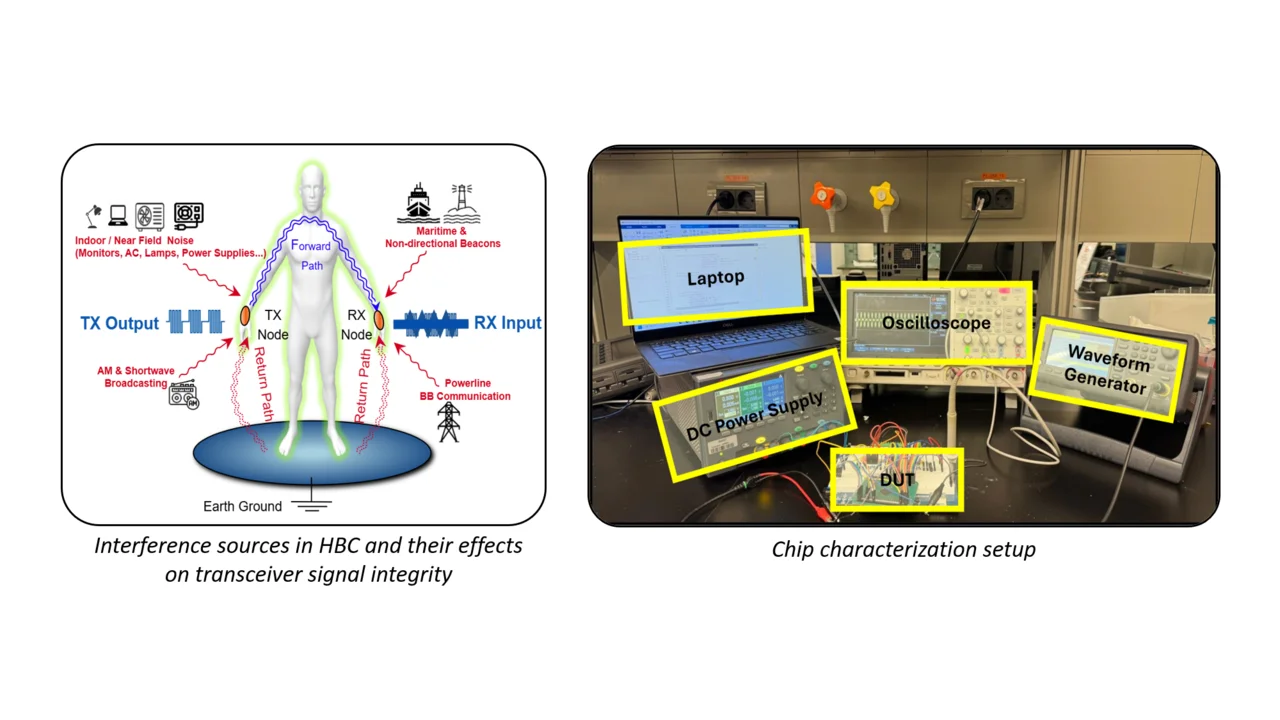
Proposed system architecture for a wearable HBC TX and standalone RX
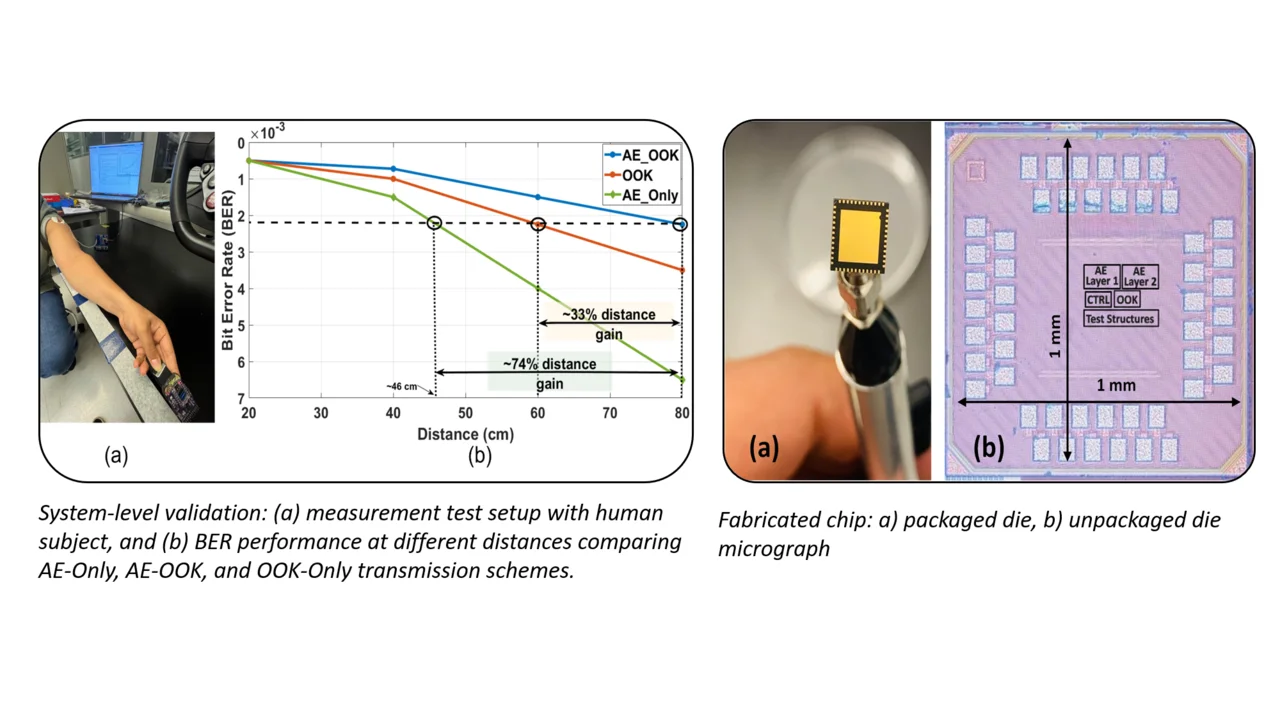
HBC-II: Interference-aware adaptive-frequency transceiver with an on-chip MCU
Below 10 MHz the EQS channel is quiet in the radiative sense but crowded in the conducted sense. Rather than buying robustness with conservative carrier-to-data-rate ratios, HBC-II measures the channel and moves. A tiny on-chip microcontroller performs real-time channel assessment, drives adaptive frequency hopping as interference-driven channel selection, and interfaces sensors directly — no external host anywhere in the control loop.
- RecSilicon: 65 nm CMOS · 0.117 mm² · complete analog front-end integrated with the digital baseband.
- eive chain: preamplifier → envelope detector → post-amplifier → comparator → 3-bit ADC.
- Data rate 22 – 360 kbps; energy efficiency 62.2 – 79.5 pJ/bit.
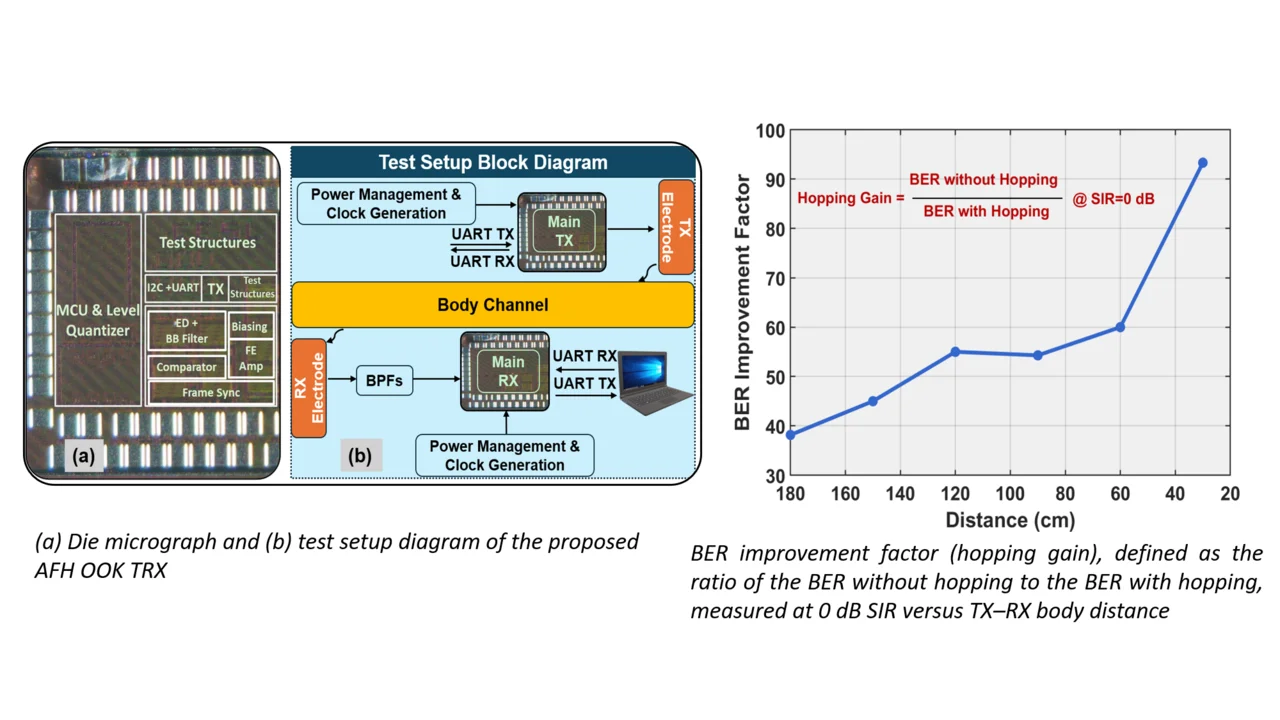
- Robustness: −33 dB signal-to-interference ratio tolerated at BER = 10⁻³.
- 40× BER improvement over single-frequency operation at 180 cm body distance — the full length of an on-body link.
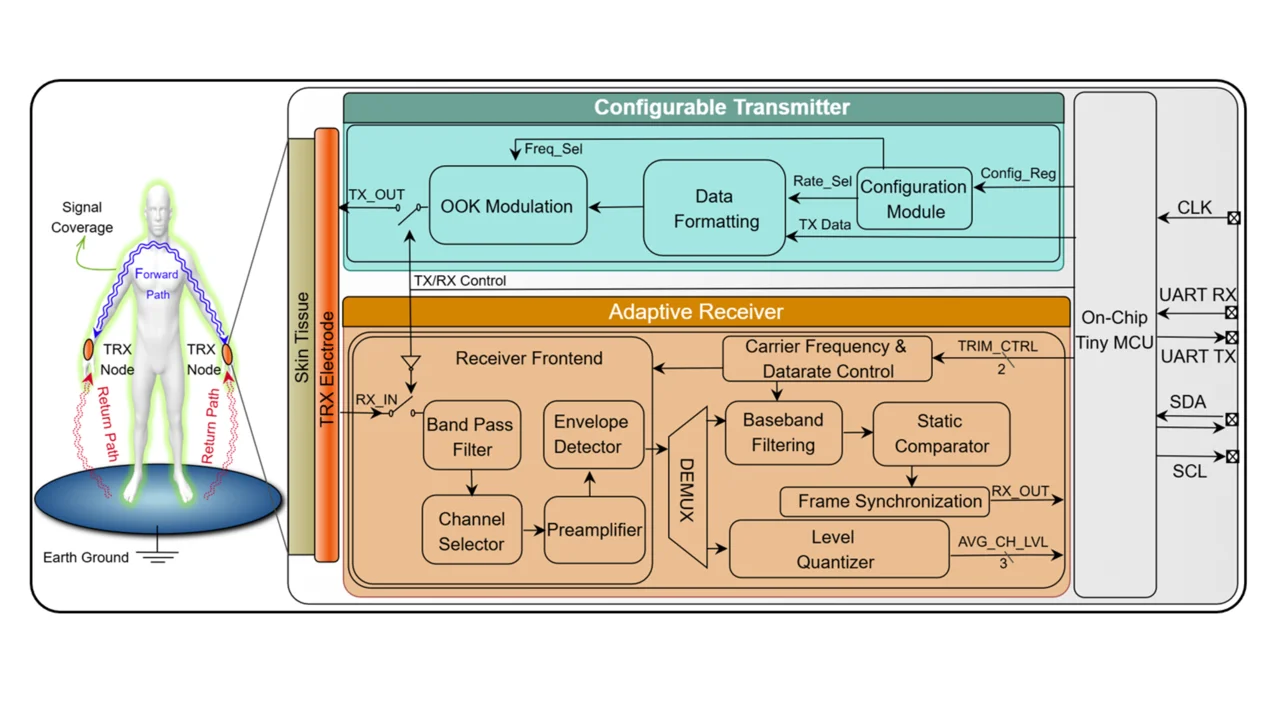
Proposed architecture for the adaptive frequency hopping HBC transceiver
HBC-III: Digital body-resonance platform with an embedded microcontroller
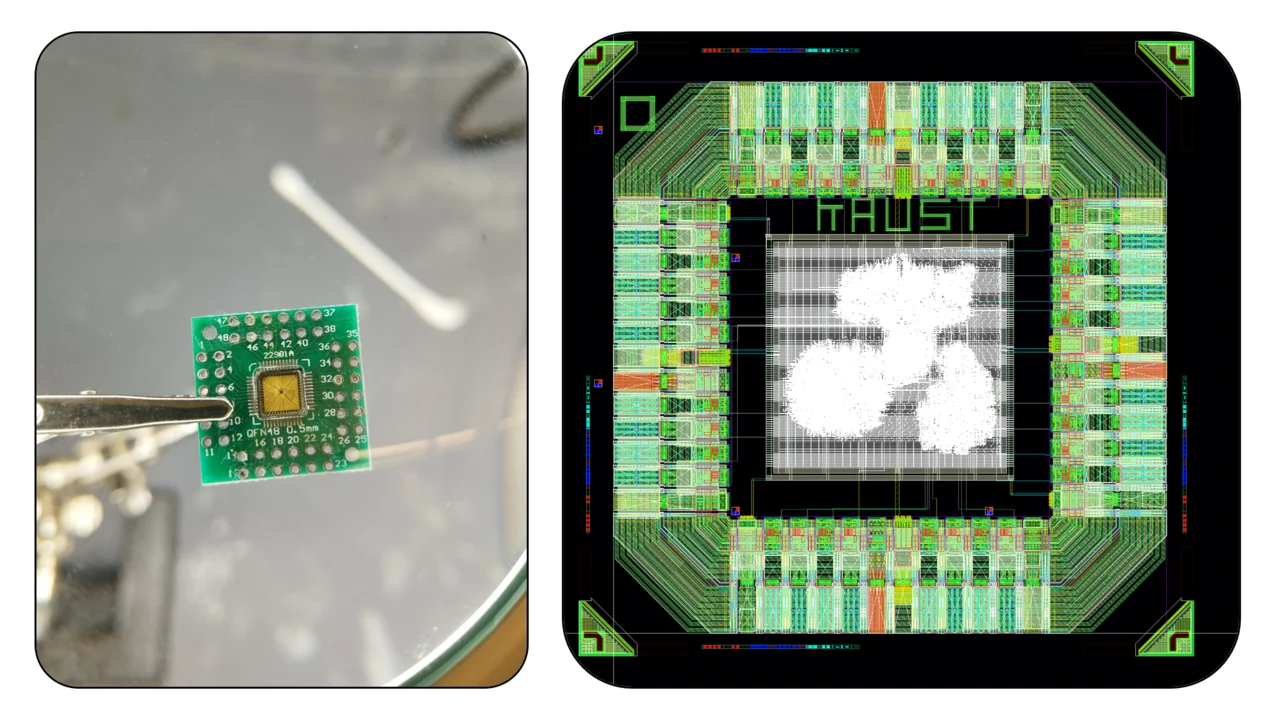
HBC-III moves the architecture out of the EQS band. It keeps the digital-first flow and the MCU-centred control of HBC-II — OOK framing, programmable data rate, direct sensor interfacing — but drops the autoencoder path and the ExG front-end, and retargets the entire design to high-frequency operation with an embedded microcontroller clocked up to 100 MHz. Its purpose is to establish body-resonance operation as a practical high-throughput mode for HBC rather than a laboratory curiosity, and to give the group a digital platform on which the framing, CRC and data-recovery blocks are brought up before they are hardened alongside full-custom analog in HBC-IV.
- Role: bridge generation — from sub-10 MHz EQS narrowband links to Mb/s-class body-resonance links.
- Embedded MCU operating up to 100 MHz, opening the throughput headroom that streaming physiological signals require.
- Status: characterisation in progress; measured results and figures will be added to this page as they are released.
HBC-IV: Complete body-channel transceiver on a single die
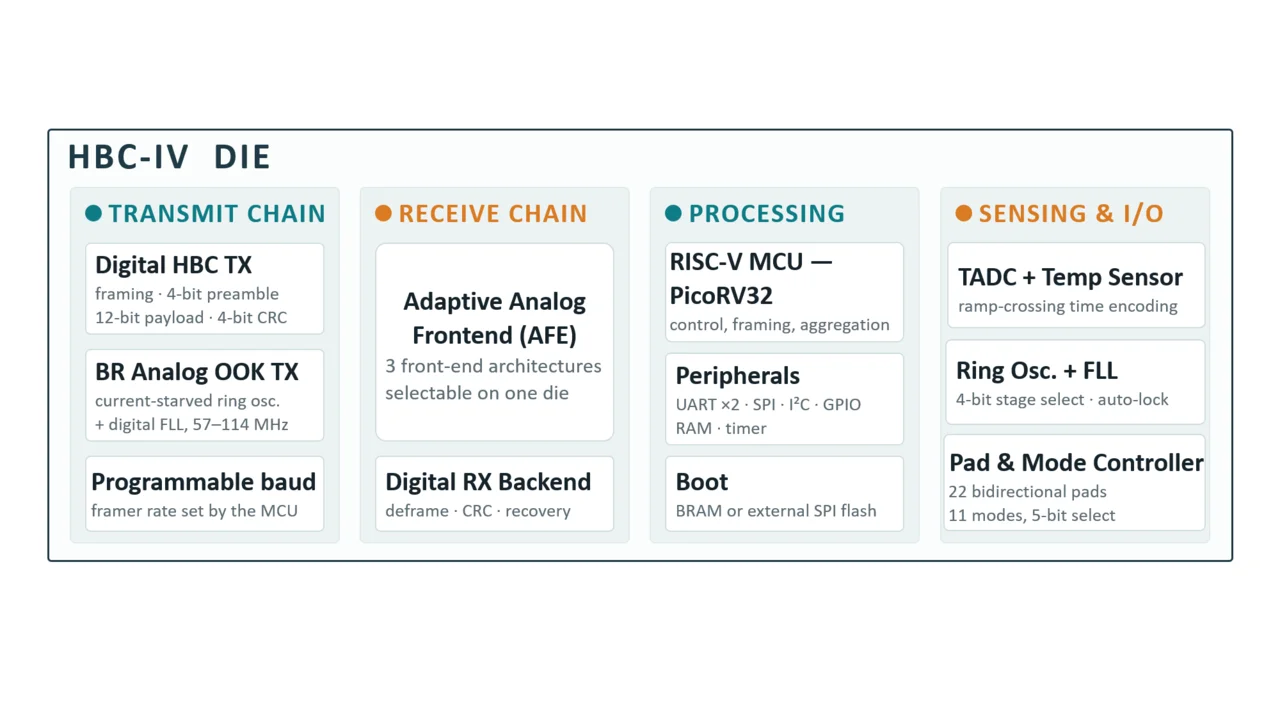
HBC-IV puts both directions of the link, a RISC-V microcontroller and on-chip sensing onto one die, so that a single part can be placed anywhere on the body and configured for the role that node has to play.
Transmit chain
A digital HBC transmitter — 4-bit preamble, 12-bit payload, 4-bit CRC, programmable baud — drives a full-custom body-resonance analog OOK transmitter: a three-stage current-starved ring oscillator with a beta-multiplier self-biased reference and a purely digital frequency-locked loop, with on/off keying applied directly at the oscillator bias. This divider-free direct-oscillator-keying scheme covers the 40–120 MHz band.
Receive chain
Two front-ends share the die. AFE-1 is a low-complexity, clock-free demodulation path: inverter-based gain stages → differential-pair envelope detector with current summing → integrating comparator. AFE-2 is an adaptive front-end carrying three selectable architectures (self-biased, differential, single-ended) with four-level programmable bias current, a tunable low-pass filter, and observation taps after the envelope detector, baseband amplifier and comparator — so all three can be characterised on one prototype without a chip revision. A digital receive backend then performs deframing, CRC checking and data recovery.
Processing, sensing and configurability
A PicoRV32 RISC-V core with RAM, timers, two UARTs, SPI, I²C and 32-bit GPIO, with firmware loaded over UART and boot from BRAM or external SPI flash; alongside a ramp-crossing time-encoded ADC and an on-chip temperature sensor. A mode and pad controller exposes 22 bidirectional pads with per-pad direction control and 11 operating modes under a 5-bit select — so the same die sits at the chest, the wrist or any other band, with only the half of the chain that node needs powered up.
Results
Two generations are silicon-measured and published; the body-resonance transmitter of HBC-IV is characterised post-layout in the accepted ICECS 2026 paper. Measured HBC-III and HBC-IV numbers will be added to this page once characterisation completes.
| HBC-I | HBC-II | BR OOK TX |
Technology | TSMC 65 nm, 0.7 V | 65 nm CMOS | TSMC 65 nm GP, 1 V |
Area | 0.01 mm² | 0.117 mm² | 70 × 30 µm² (TX core) |
Regime | EQS, programmable carrier | EQS, sub-10 MHz, adaptive hopping | Body resonance, 40–120 MHz |
Data rate | 2.3 kbps – 1 Mbps | 22 – 360 kbps | 8 – 24 Mb/s (f_RF / 5) |
Core power | 65 nW – 1.4 µW | not reported separately | 7.8 – 12.3 µW |
Energy efficiency | 1.3 – 31.4 pJ/bit | 62.2 – 79.5 pJ/bit | 0.51 – 0.98 pJ/bit |
Headline result | 33 % / 74 % range extension over OOK / AE-Only | −33 dB SIR at BER 10⁻³; 40× BER improvement at 180 cm | Divider-free direct oscillator keying with a digital FLL |
Applications
The same transceiver line supports three applied directions. Two use the body channel as a communication link; the third uses it as a measurement instrument.
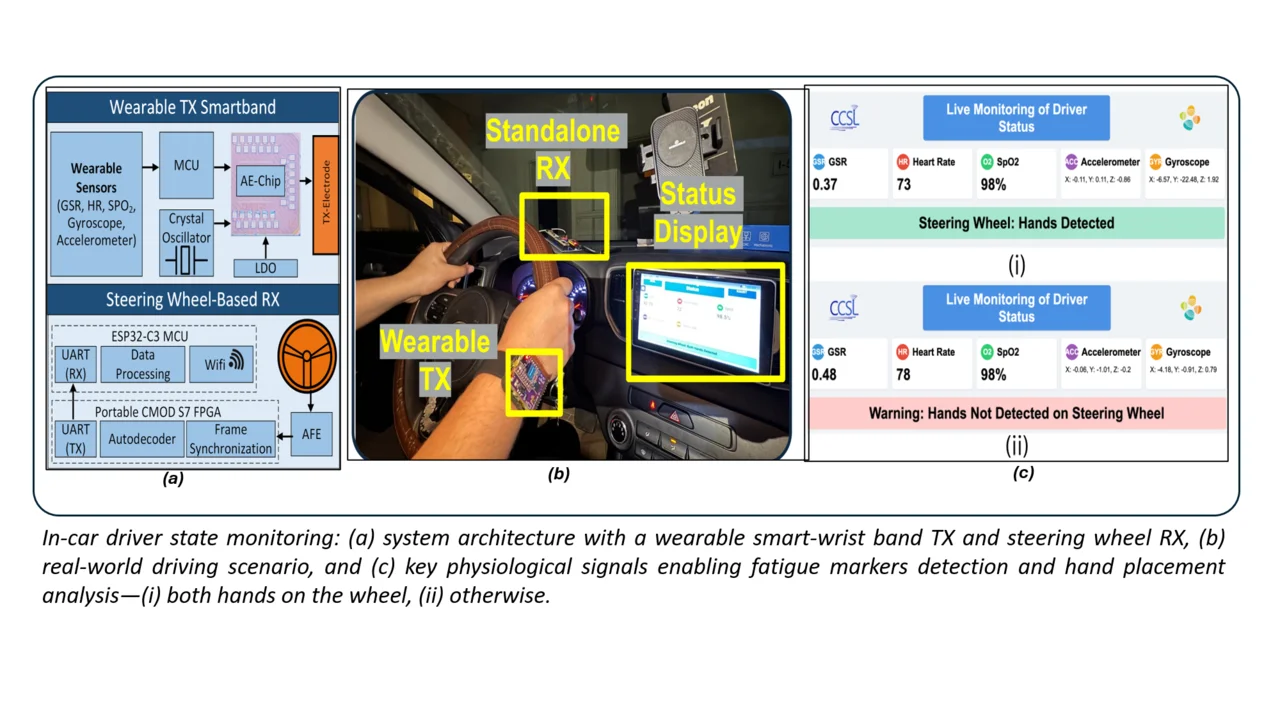
1. In-car driver state monitoring
Privacy-preserving vigilance monitoring — the vehicle becomes the receiver
The clearest demonstration of HBC-I's asymmetric-power idea. A smart wrist band carries the transmitter together with galvanic skin response, heart-rate, SpO₂, accelerometer and gyroscope sensors. Physiological data is coupled into the driver's body and picked up by a standalone receiver hidden in the steering wheel — no camera in the cabin, and no radio link to intercept.
- Continuous fatigue-marker extraction from physiological signals, without the privacy cost of camera-based driver monitoring.
- Hand-on-wheel detection comes for free: the link only closes when the driver is in contact with the wheel electrode, so hand placement is inferred from the channel itself.
- Directly relevant to fleet operators and any institution that needs continuous driver-vigilance monitoring under privacy constraints.
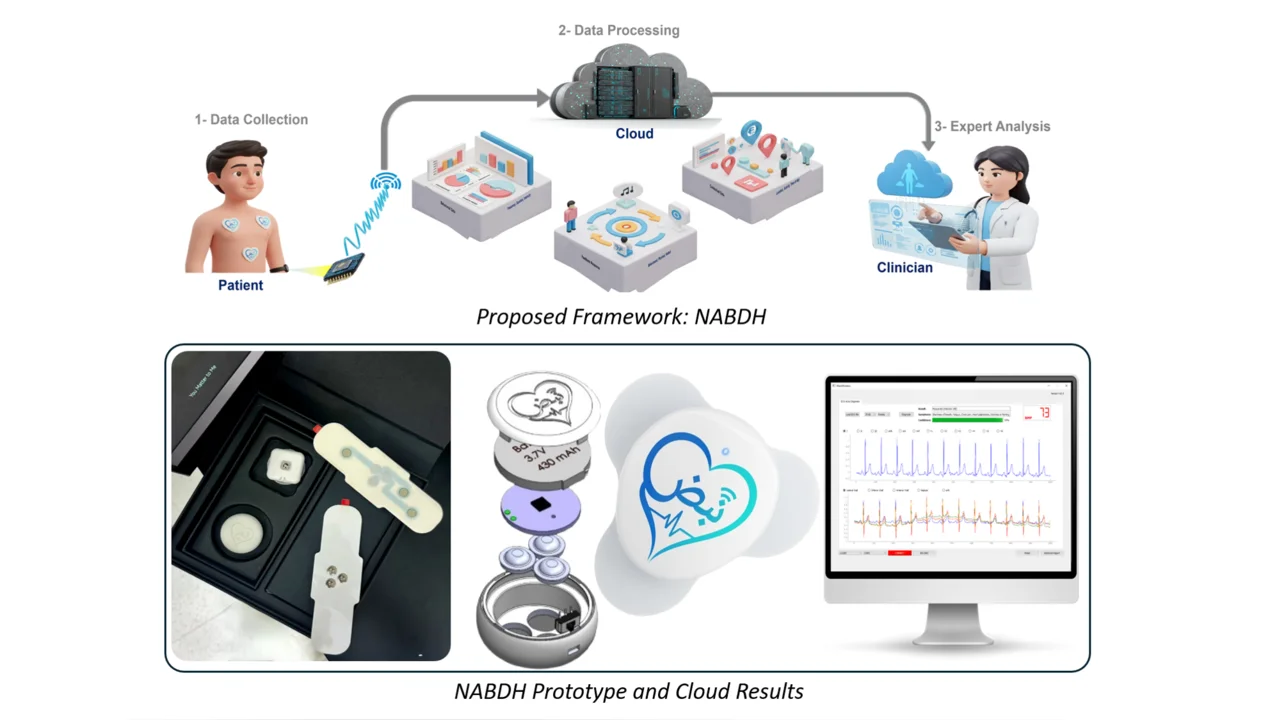
2. NABDH — a wireless Holter over the body
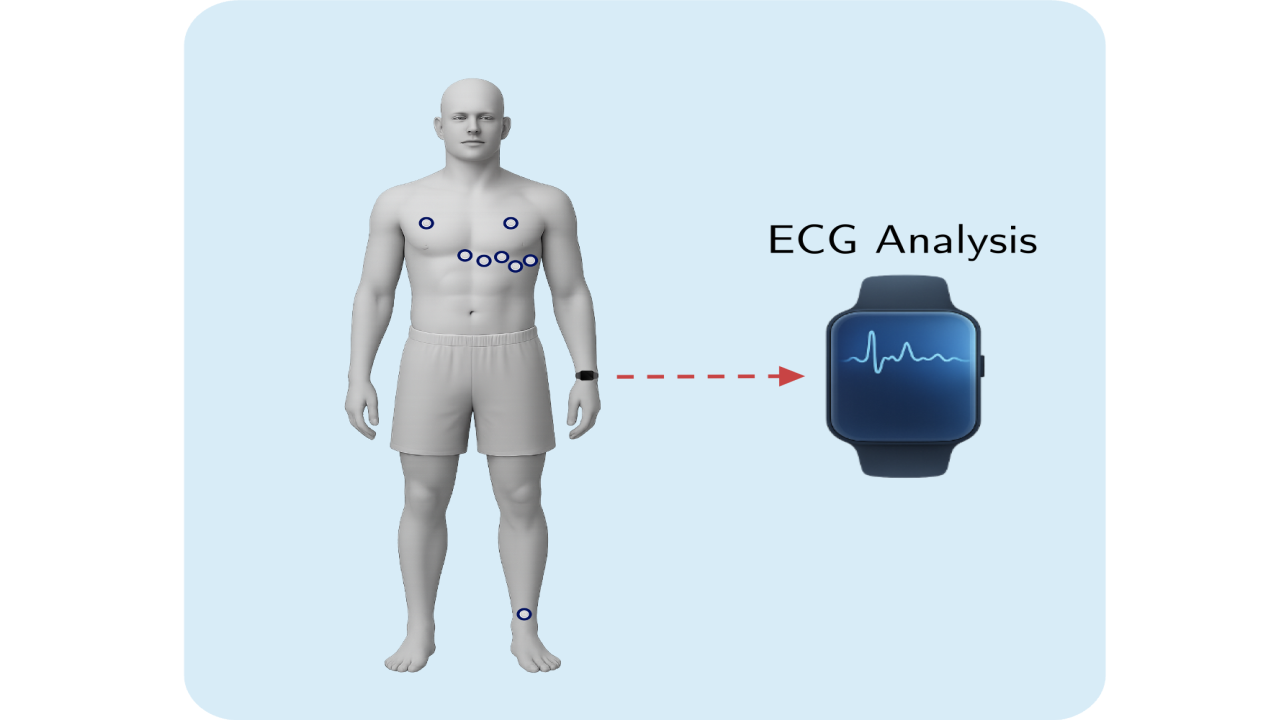
NABDH replaces the wired Holter monitor with slim body-worn patches that carry ECG through the wearer instead of over the air. It is the flagship system application for HBC-IV, and the reason the chip integrates both halves of the link on one die.
- Chest node — ECG electrodes and a custom ExG readout (instrumentation amplifier, programmable gain, right-leg drive, lead-off detection) feeding a low-power microcontroller, then the HBC-IV transmit chain. The receive chain stays powered down, removing its bias current.
- Wrist node — the HBC-IV receive chain recovers the chest ECG, while IMU, temperature and PPG are read locally. The on-chip RISC-V core timestamps and fuses everything on a single timebase, so nothing needs post-hoc synchronisation.
- One radio in the whole system: a single BLE uplink from the wrist to a phone or gateway, with local flash logging when the gateway is out of range.
- Measured current draw falls from ≈ 419 mA for an ESP32-C3 RF link to ≈ 20 mA over HBC, and below 1 mA with the CCSL HBC ASIC — a 99.7 % reduction, alongside a roughly 10× smaller form factor.
3. Non-invasive hydration status detection
The communication channel used as a biomarker
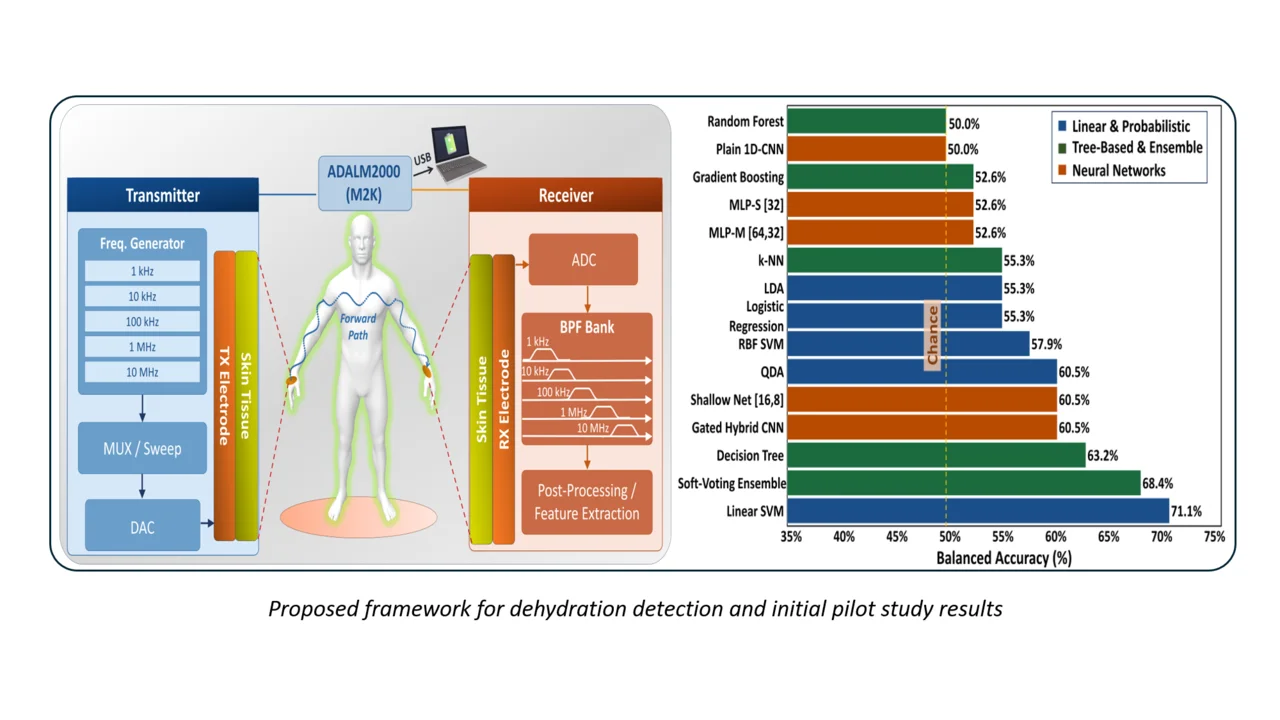
Hydration changes the dielectric and conductive properties of tissue — and therefore changes the HBC channel transfer function. This work turns that side effect into the measurement: no additional sensor, no consumable, just the link the wearable already has.
- Arm-to-arm galvanic setup with 5 × 5 cm dry copper electrodes driven at 1 Vpp; channel gain swept over five frequency bands from the kHz range into the tens of MHz.
- Pilot study with seven healthy subjects, evaluated as a binary hydrated / fasting classification over 89 extracted features.
- Leave-one-subject-out cross-validation throughout — the only honest protocol at this dataset size; results are reported at pilot scale, not as a generalisable claim.
- A four-band subset (1 kHz, 100 kHz, 1 MHz, 20 MHz) outperforms the full five-band configuration by roughly five percentage points; one band is measurably harmful and is dropped.
Recognition
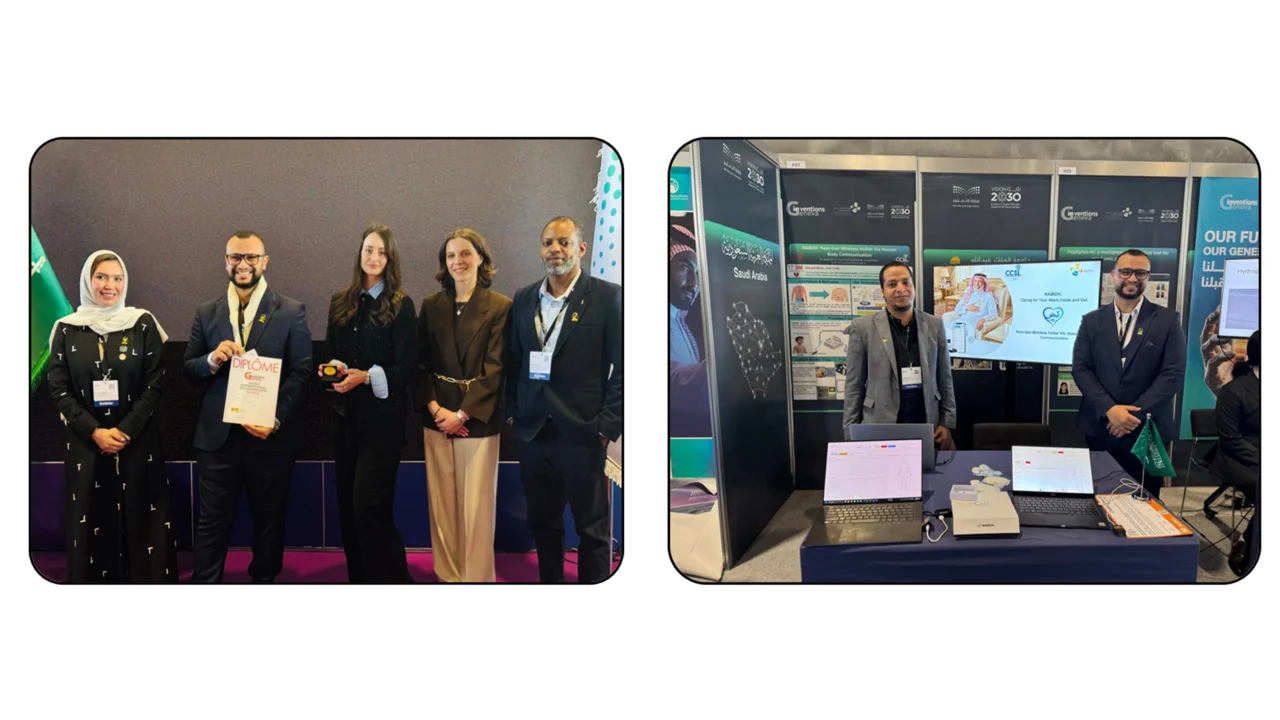
Gold Medal — International Exhibition of Inventions of Geneva 2026
“NABDH: Next-Gen Wireless Holter Via Human Body Communication”
Cardiovascular disease accounts for roughly 32 % of global deaths — about 17.9 million a year — and many fatal arrhythmias go undetected simply because the monitors that would catch them are bulky, power-hungry and uncomfortable to wear for long periods. NABDH was recognised for closing that gap with silicon rather than with a bigger battery: slim patches that stream ECG through the body itself, to a local hub and on to a clinician.
>100× energy efficiency vs. on-body RF | 10× smaller form factor | 24/7 continuous ECG monitoring | 0 wires on the patient |
Copyright
The data and results presented in this work are protected by copyright and may only be used with proper citation. Any use of this work should reference the following papers:
- A. N. Abdelrahman, A. Ali, A. Celik, and A. M. Eltawil, “A Low Power Human Body Communication Transmitter with Pre-trained Encoder and Reconfigurable Decoder for Standalone Receiver Applications,” IEEE Open Journal of Circuits and Systems, vol. xx, pp. xx–xx, xx 2026.
- A. N. Abdelrahman, A. Ali, M. Ali, A. Hassan, and A. M. Eltawil, “An Interference-Aware Adaptive Frequency Channel Selection Transceiver for Low Power Human Body Communication,” IEEE Transactions on Biomedical Circuits and Systems, early access, 2026, doi: 10.1109/TBCAS.2026.3724074.
- A. N. Abdelrahman, A. Ali, A. Celik, and A. M. Eltawil, “An Energy Efficient Divider-Free Body-Resonance Transmitter with Direct Oscillator Keying for Human Body Communication,” in Proc. IEEE Int. Conf. on Electronics, Circuits and Systems (ICECS), 2026, pp. xx–xx.
- A. N. Abdelrahman, A. Ali, A. Celik, and A. M. Eltawil, “Non-Invasive Hydration Status Detection via Human Body Communication,” in Proc. IEEE Int. Conf. on Electronics, Circuits and Systems (ICECS), 2026, pp. xx–xx.
- A. N. Abdelrahman, A. Ali, M. Ali, A. Hassan, A. Celik, and A. M.Eltawil, “An Adaptive Dual-Mode HBC Transceiver for Medical and Entertainment Applications,” in 2025 IEEE Biomedical Circuits and Systems Conference (BioCAS), 2025, pp. 106–110
- A. Ali, A. N. Abdelrahman, A. Celik, and A. M. Eltawil, “Autoencoder-Based Transceivers for Multiple Access Human Body Communication Networks,” IEEE Trans. Circuits and Systems I: Regular Papers, vol. 72, no. 12, pp. 8132–8145, Dec. 2025.
- A. Ali, A. N. Abdelrahman, A. Celik, M. E. Fouda, and A. M. Eltawil, “A Robust Autoencoder HBC Transceiver with CGAN-Based Channel Modeling,” IEEE Sensors Journal, vol. 25, no. 9, pp. 15935–15949, May 2025.
- A. Ali, A. N. Abdelrahman, A. Celik, and A. M. Eltawil, “EQS-Band Human Body Communication through Frequency Hopping and MCU-Based Transmitter,” Smart Health, vol. 32, art. 100471, 2024.
- A. N. Abdelrahman, M. E. Fouda, and A. M. Eltawil, “A −96.2 dBm / 3.5 µW Wake-up Receiver with False Triggering Detection for Human Body Communication,” in Proc. 30th IEEE Int. Conf. on Electronics, Circuits and Systems (ICECS), 2023, doi: 10.1109/ICECS58634.2023.10382780.
- A. N. Abdelrahman, D. Lago-Cachón, M. E. Fouda, and A. M. Eltawil, “On Body Characterization of Flexible Electrodes for Human-Body Communication,” in Proc. IEEE 66th Int. Midwest Symp. on Circuits and Systems (MWSCAS), 2023, doi: 10.1109/MWSCAS57524.2023.10405938.
Award: A. Abdelrahman, A. Ali and A. M. Eltawil, “NABDH: Next-Gen Wireless Holter via Human Body Communication,” Gold Medal, International Exhibition of Inventions of Geneva, 2026.