Skip to main content
Communication and Computing Systems Lab
Communication and Computing Systems Lab
Home
People
All Profiles
Principal Investigator
Postdoctoral Fellows
Research Scientists
Research Staff
Students
Alumni
Former Members
Research
Wireless Communication
Body Area Network
Applied Artificial Intelligence
All Projects
Publications
Publications
Google Scholar
DBLP
IEEE Xplore
KAUST Repository
ORCID
Events
Media Gallery
Contacts
News
Join us
Redesigning
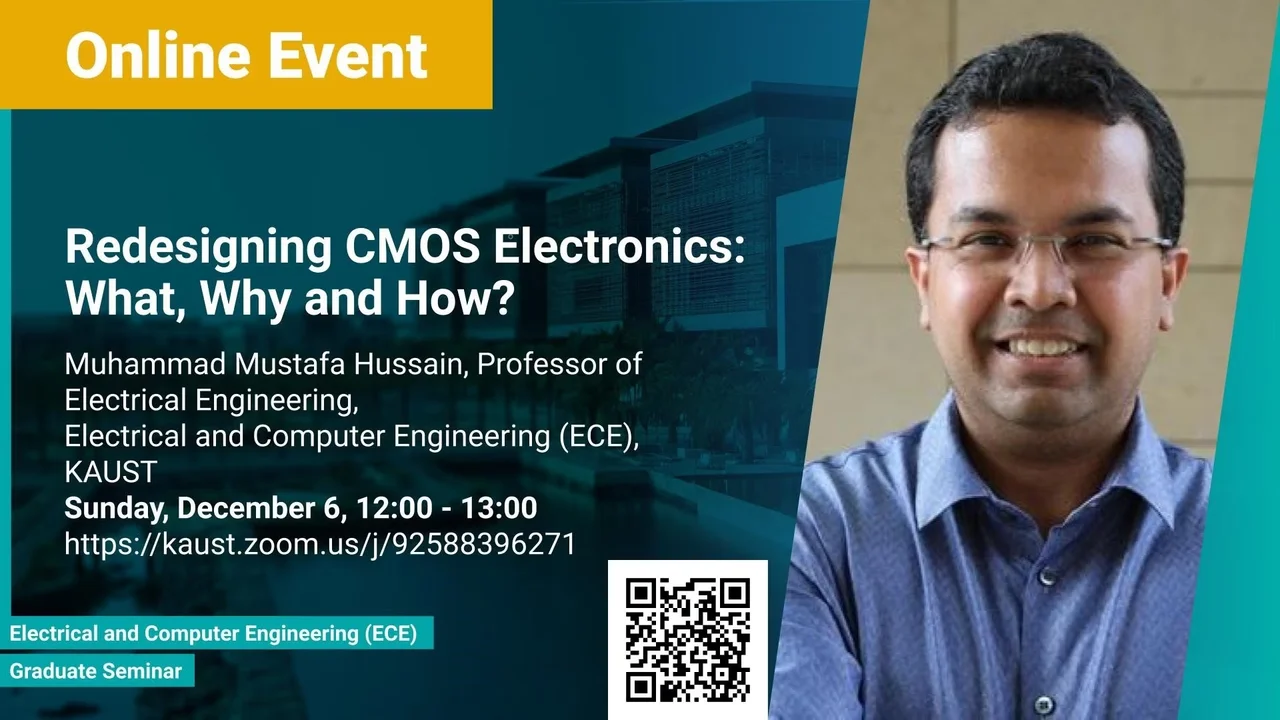
Redesigning CMOS Electronics: What, Why and How?
Dec 6, 12:00
-
13:00
KAUST
Redesigning
CMOS
electronics
A little more than half of the world’s population enjoy benefits of information technology which is enabled by complementary metal oxide semiconductor (CMOS) electronics. Going forward, we will enjoy further augmentation of quality of life through integrated CMOS electronic systems consisting of logic, memory, communication devices, energy storage and harvester, power management units, sensors and actuators. Their main attributes will include but not limited to high performance and storage capacity for data management; seamless connectivity; energy efficiency; hyper-scale integration density; appropriate functionalities based on their applications and operational environment; reliability and safety; and finally affordability and simplicity to expand their user base to include those who do not have any access to them today. Even using last fifty years’ wealth of knowledge and experience, such integrated electronic system development and deployment is a monumental engineering challenge. From that perspective, redesigning CMOS electronics might seem to be an overly ambitious goal specially, if that means transformation of such physically rigid complex electronic systems into a fully flexible one. To address this intriguing challenge, we have developed a unique coin like architecture based soft singular platform, which can be used as the building block of standalone fully flexible CMOS electronic system with all the aforementioned characteristics. We have devised an effective heterogeneous integration strategy based on mature and reliable CMOS technology only to integrate hybrid materials and diverse set of devices for multi-disciplinary applications. These will be the focus of this talk.