Skip to main content
Communication and Computing Systems Lab
Communication and Computing Systems Lab
Home
People
All Profiles
Principal Investigator
Postdoctoral Fellows
Research Scientists
Research Staff
Students
Alumni
Former Members
Research
Wireless Communication
Body Area Network
Applied Artificial Intelligence
All Projects
Publications
Publications
Google Scholar
DBLP
IEEE Xplore
KAUST Repository
ORCID
Events
Media Gallery
Contacts
News
Join us
MoS2
Experimental Verification of a Fractional-Order Wien Oscillator Built Using Solid-State Capacitors
1 min read ·
Thu, Apr 26 2018
News
MoS2
Circuits
foc
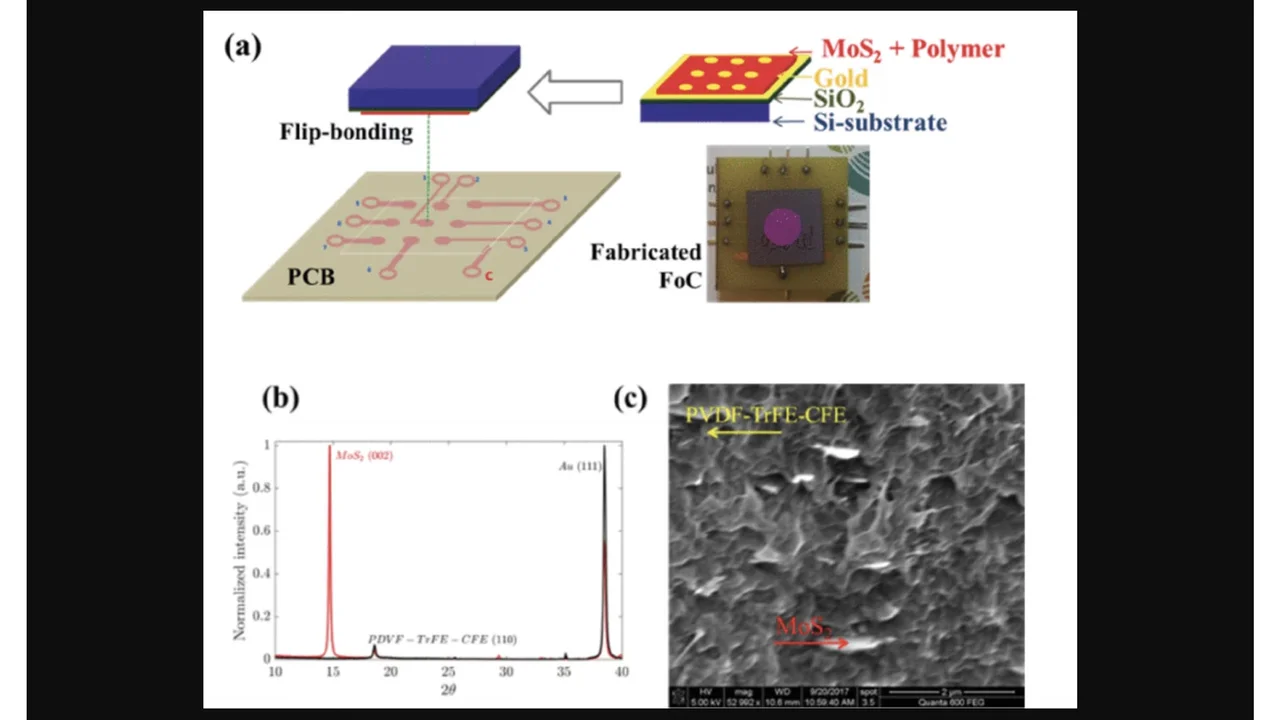
Kartci, Aslihan, et al. "Experimental Verification of a Fractional-Order Wien Oscillator Built Using Solid-State Capacitors." 2018 IEEE 61st International Midwest Symposium on Circuits and Systems (MWSCAS). IEEE, 2018, 544. A new type of fractional-order capacitors (FOCs) is fabricated using a molybdenum disulfide (MoS 2 )-ferroelectric polymer composite. The phase angle of this FOC's impedance remains constant between 100 Hz and 10MHz with only a small deviation of ±4 degrees. The performance of the fabricated FOCs is further tested using the well-known Wien oscillator. The main motivation of
An ultra-broadband single-component fractional-order capacitor using MoS2-ferroelectric polymer composite
2 min read ·
Thu, Apr 26 2018
News
MoS2
Circuits
foc
Agamyrat Agambayev, et al., "An ultra-broadband single-component fractional-order capacitor using MoS2-ferroelectric polymer composite". Applied Physics Letters, 113(9),2018, 093505. The phase angle of a fractional-order capacitor's (FOC) impedance has a constant value between −90°−90° and 0°0°. Maintaining this value over a broad frequency band is of utmost importance since it increases the applicability of the electrical circuit that employs the fractional-order capacitor (FOC). In this work, a molybdenum disulfide (MoS2)-ferroelectric polymer composite is used to design/fabricate an FOC