BioContact Assurance System
Overview
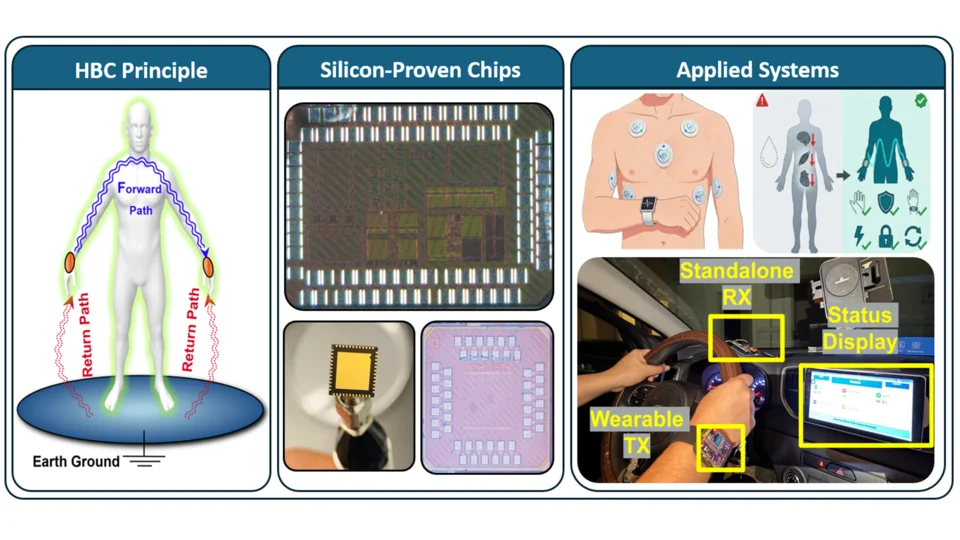
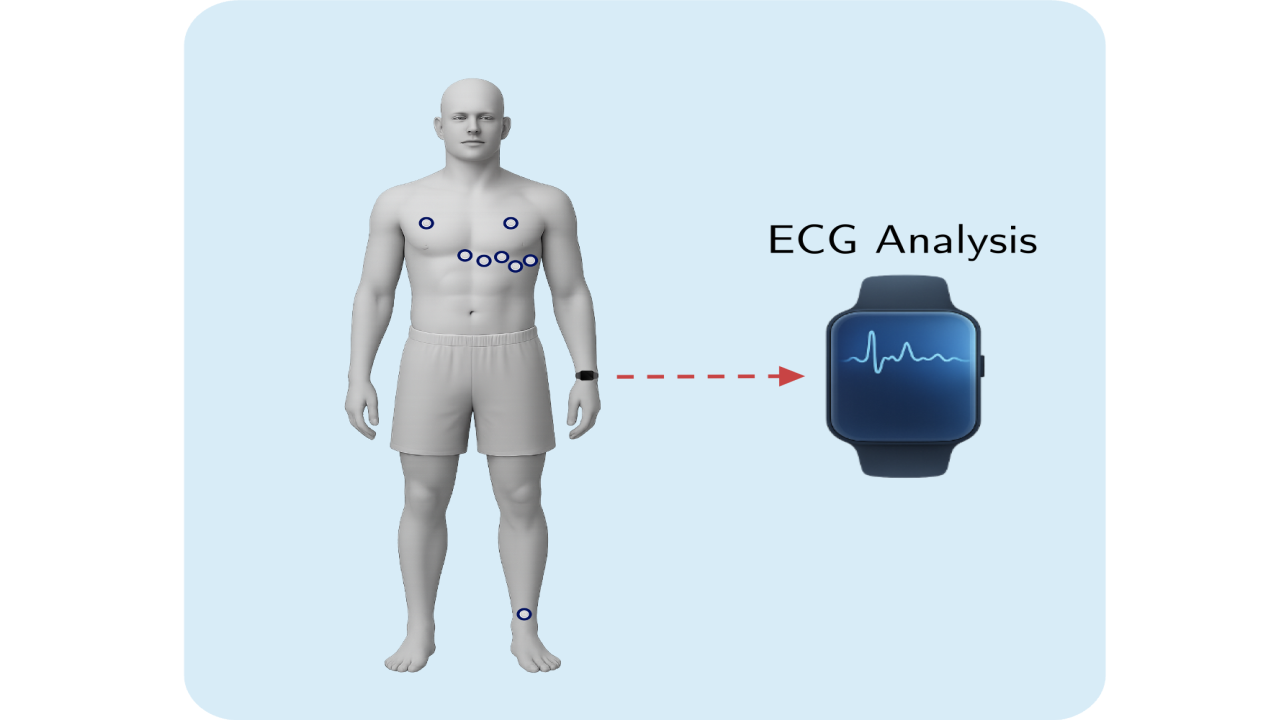
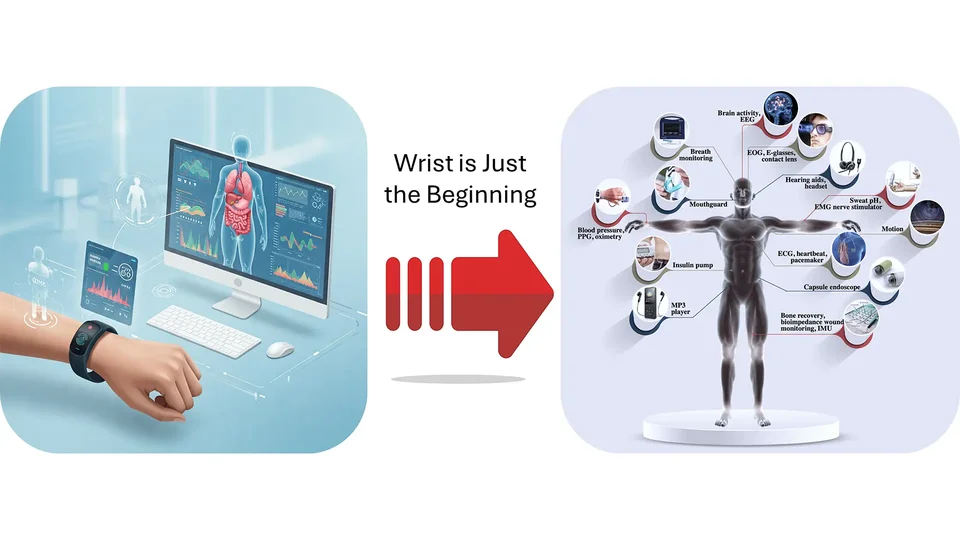
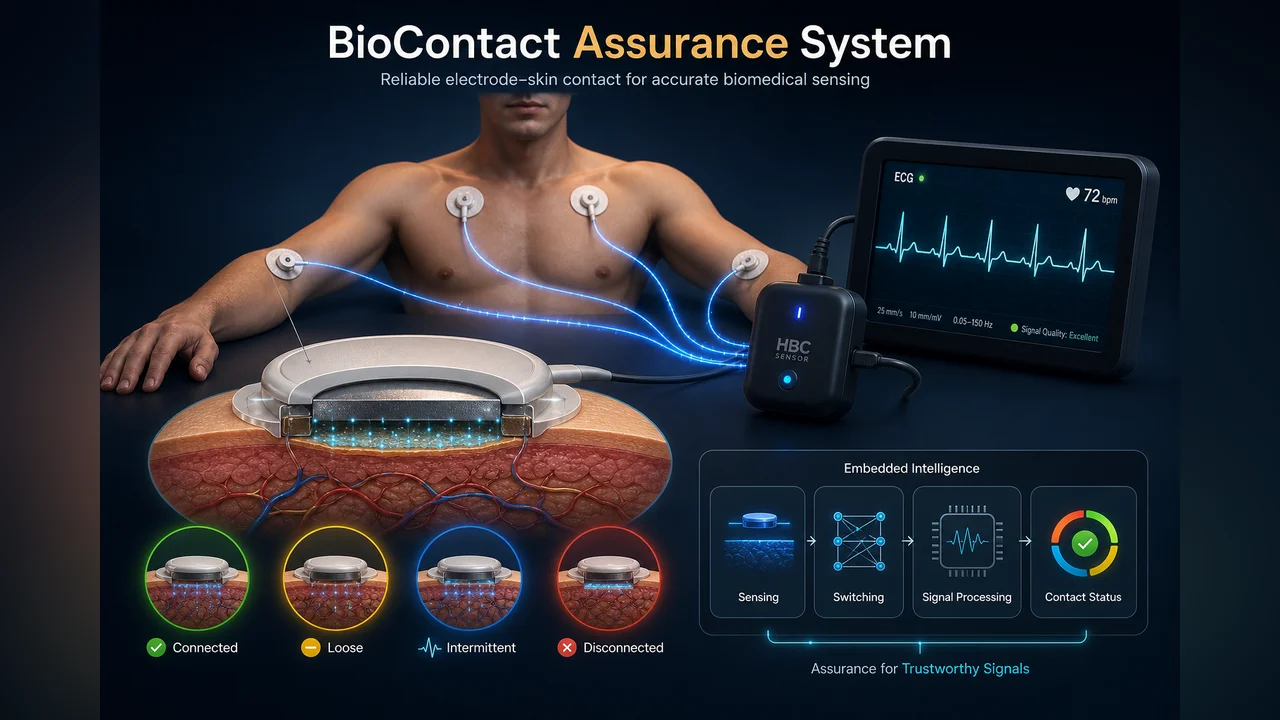
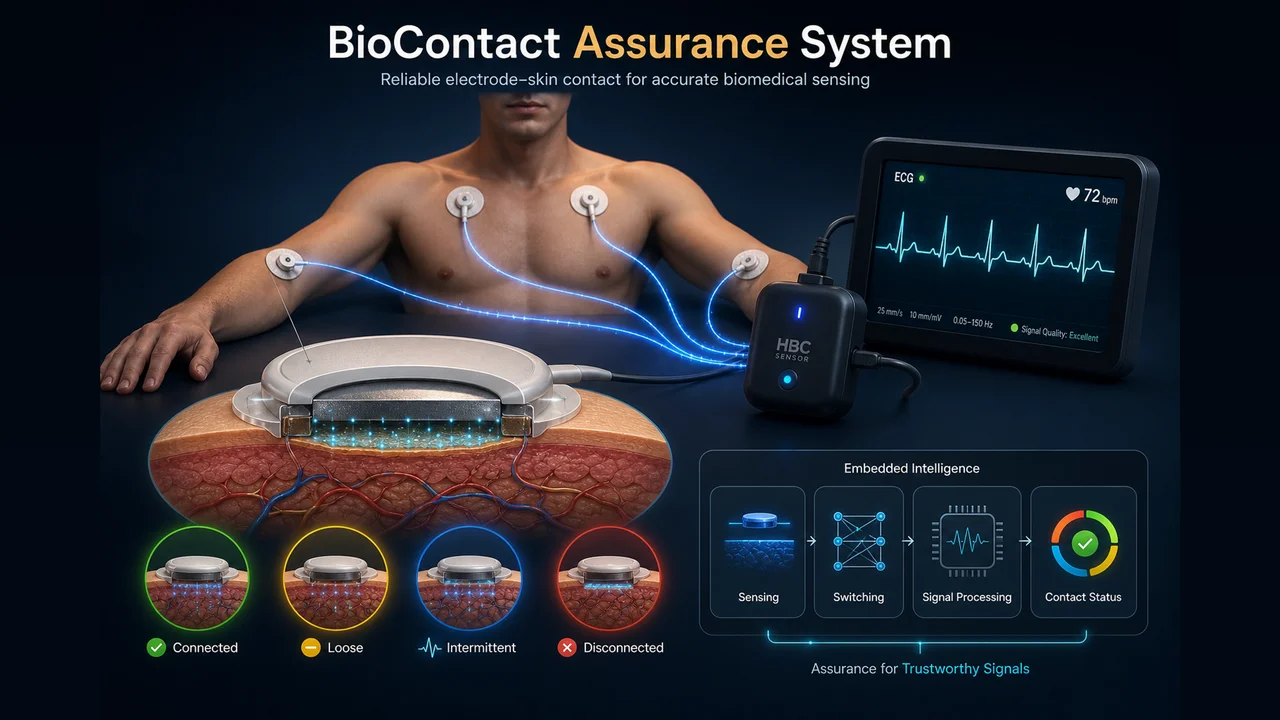
Reliable electrode-skin contact is fundamental for accurate biomedical signal acquisition in applications such as ECG, EEG, and EMG monitoring. Traditional lead-off detection methods face challenges from motion artifacts, environmental noise, and fluctuating skin-electrode impedance. The BioContact Assurance System (BCAS) leverages common-ground human body communication (CG-HBC), utilizing the human body itself as a signal transmission medium. BCAS enables real-time electrode contact monitoring and verification, paving the way for improved performance in wearable healthcare devices and broader Internet of Bodies (IoB) applications.
System Architecture
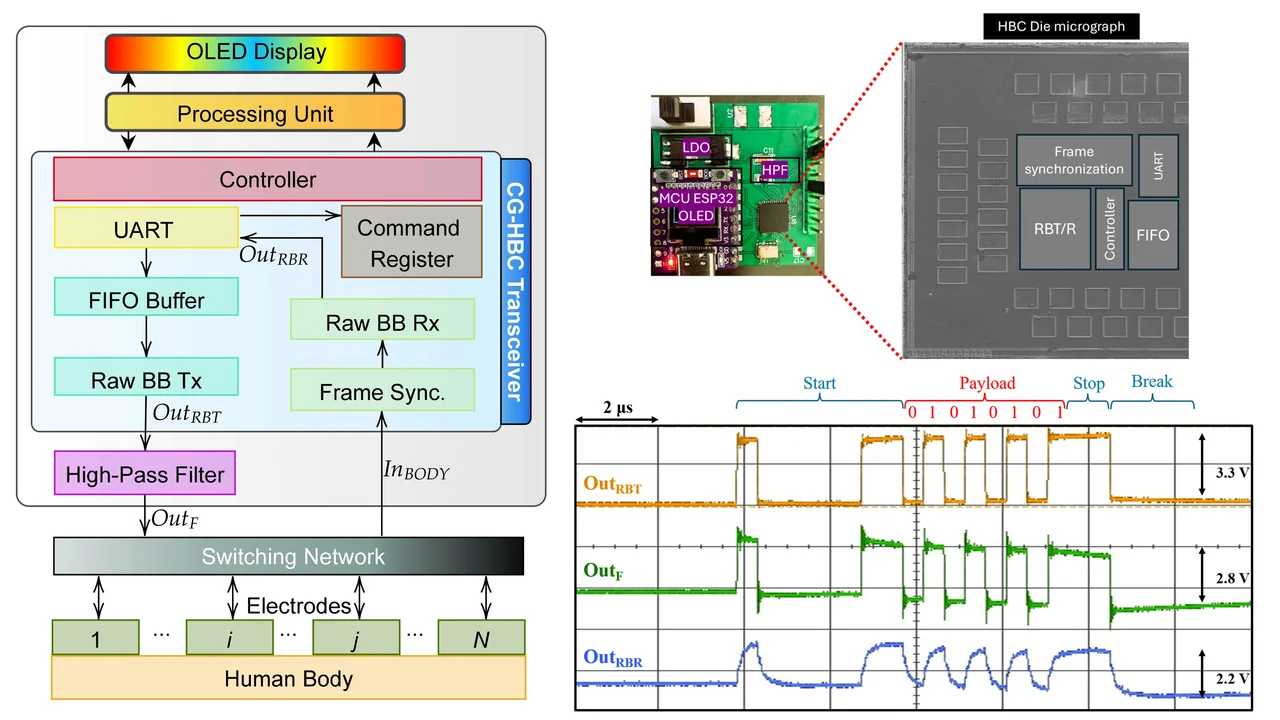
The BCAS is architected around three primary components that work in unison to ensure real-time and reliable electrode contact monitoring: the CG-HBC transceiver, a processing unit, and a switching network.
At the core is the CG-HBC transceiver, a custom-designed integrated circuit fabricated using TSMC 65nm CMOS technology aimed at ultra-low power consumption and small footprint. This design choice significantly reduces system complexity, power consumption, and interference-related performance degradation common in other human body communication methods. The transceiver supports adjustable data rates ranging from 1 kbps to 13.5 Mbps by varying the operating clock frequency, allowing the system to balance power efficiency and responsiveness according to application needs.
The processing unit is typically implemented via a microcontroller that interfaces with the CG-HBC transceiver through a UART communication protocol. This unit performs essential functions including decoding digital packets received via the human body, analyzing transmission success rates, bit error rates (BER), and other link quality metrics.
For biomedical systems with multiple electrodes, a switching network is incorporated to enable systematic validation of connection status across all electrodes. This switching network manages the selection and connection of transmitting and receiving electrodes.
Signal processing within the CG-HBC transceiver includes a high-pass filter that removes low-frequency interference overlapping the frequency spectrum of biomedical signals. The system's architecture is modular, allowing BCAS to be integrated as an add-on IP block into existing bio signal acquisition systems with minimal hardware modifications or deployed as a standalone device complete with its processing and display units.
Transmission Protocol
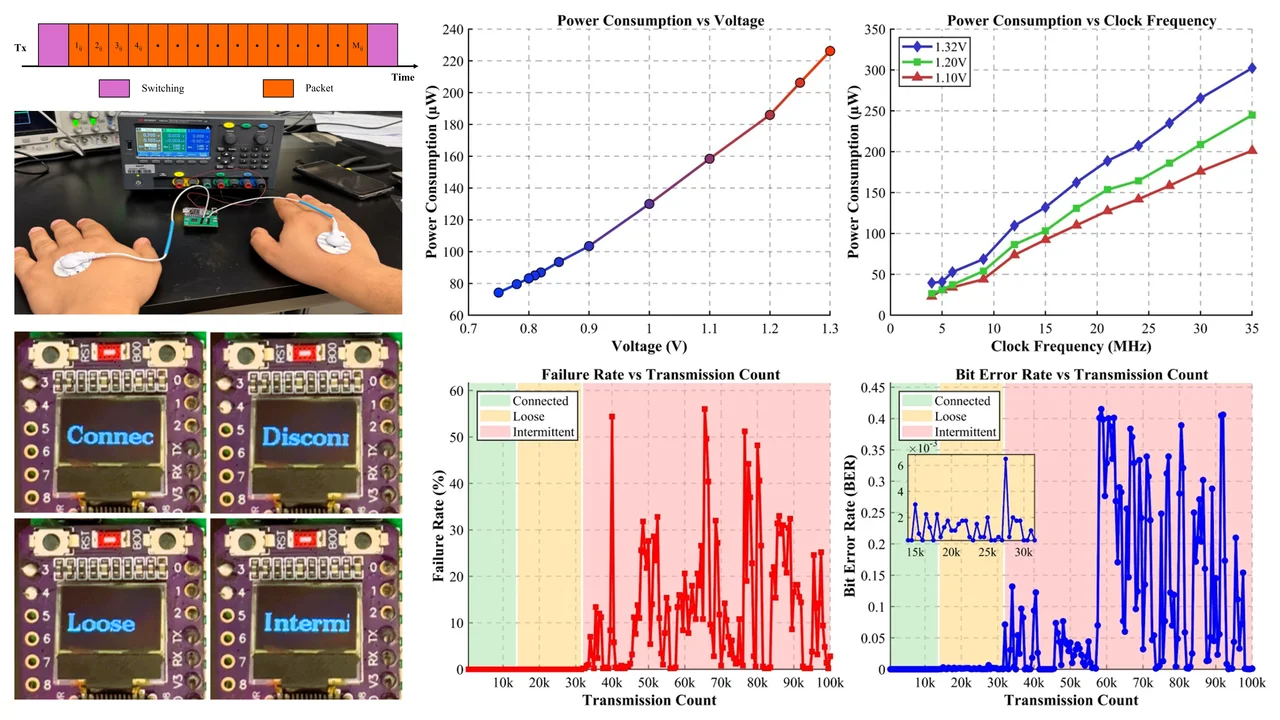
In BCAS, predefined digital data packets are sent between pairs of electrodes using a time-slotted protocol. Transmission metrics such as BER and failed responses are analyzed to classify electrode states as connected, loose, intermittent, or disconnected. For instance, error-free transmissions within expected counts signal a fully connected state, whereas elevated bit error rates indicate loose or degraded contact; intermittent failures reveal unstable connectivity, and continuous lack of response signifies disconnection. The algorithm detects reliable contact by evaluating successful transmissions and error patterns and constructs a connectivity graph for multi-electrode systems to pinpoint faulty electrodes. This digital packet-based approach overcomes limitations of traditional impedance or threshold-based methods, ensuring robust and precise contact assessment.
Results
The BCAS prototype demonstrates excellent power efficiency and diagnostic accuracy in practical evaluations. Fabricated as a compact 0.1 mm² chip consuming only 23.10 µW at a 2 Mbps data rate, the CG-HBC transceiver represents a significant leap forward in energy-efficient wearable biosensing technology. Experimental tests using controlled electrode conditions confirm BCAS’s capability to accurately discriminate between fully connected, loosely connected, intermittent, and disconnected electrodes with zero false detections during stable contacts.
Comparative studies under artificially degraded electrode conditions reveal BCAS’s superior sensitivity compared to traditional AC and DC lead-off detection methodologies. BCAS successfully identifies subtle connection degradations that conventional threshold-based methods overlook, classifying compromised states with over 98% accuracy. The system maintains continuous real-time feedback through an integrated OLED display, enabling immediate clinical intervention when required.
Moreover, the dual-metric approach—analyzing both transmission error rates and failure statistics—provides robust state classification even in noisy and dynamic environments, a critical factor for wearable devices subjected to motion artifacts and varying skin impedance during daily use. These results establish BCAS as a reliable, industry-leading solution for enhanced biomedical signal acquisition fidelity and patient safety.
Visual Demonstration
Copyright
R. Kumar, A. Ali, A. Celik, and A. M. Eltawil, “Real-Time BioContact Assurance and Status Monitoring Using Human Body Communication,” Results in Engineering, vol. 29, p. 108456, 2026.